
Application Introduction of the MCD Series Solid-State Laser
The MCD Series solid-state laser is ideally suited as a seed source, with core advantages including narrow pulse width, high beam quality, pure pulse profile, and integration-friendly design.
I. Core Positioning & Technical Principles
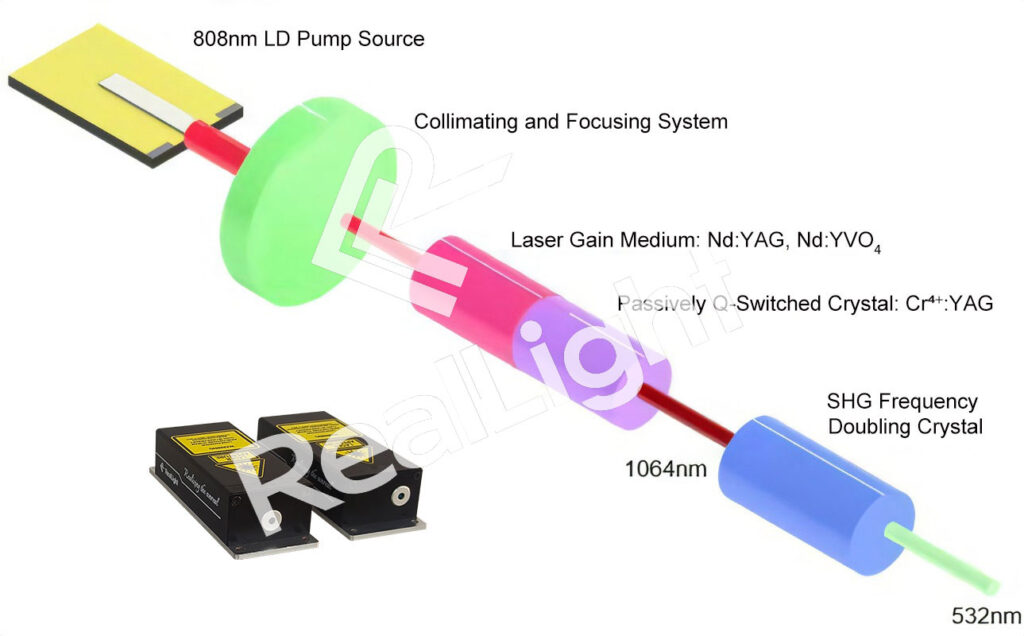
– Type: Diode-pumped, passively Q-switched solid-state microchip laser.
– Seed Source Suitability: Specifically engineered to provide low-noise, highly stable, and narrow-pulse-width initial pulses for high-power and ultrafast laser systems, serving as the “pulse origin” in amplification chains.
– Structure: Integrates the pump module and laser crystal into a fully sealed, compact unit that is easy to integrate.
II. Key Seed Source Parameters (Predominantly 1064 nm Fundamental)
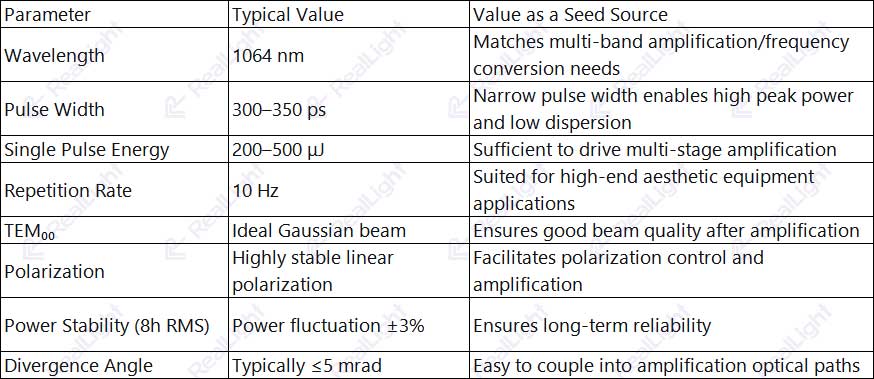
III. Core Advantages as a Seed Source
– Pure Pulse Without Tails: No trailing edges or parasitic pulses, resulting in a high signal-to-noise ratio after amplification.
– Narrow Pulse Width + High Peak Power: 300 ps-level pulse width enables MW-level peak power, ideal for picosecond/sub-nanosecond amplification chains.
– Integration-Friendly: OEM drive circuits, compact laser head, and support for internal/external triggering simplify system embedding.
– Multi-Wavelength Coverage: Fundamental plus second/third/fourth harmonics to suit various amplification and application scenarios.
– High Reliability: Fully sealed with no consumable parts, suitable for long-term industrial and research operations.
IV. Typical Application Scenarios (as a Seed Source)
– Picosecond/Sub-Nanosecond High-Power Lasers: e.g., HQF series lamp-pumped picosecond lasers directly use the MCD as the seed source.
– Lidar/Ranging: Provides narrow-pulse, high-repetition-rate seeds to improve ranging accuracy and resolution.
– Material Micro-Machining: Post-amplification for precision cutting, drilling, and scribing.
– Spectroscopy/Analysis: LIBS, LIF, Raman, etc., requiring narrow pulse width and high peak power excitation.
– Research Amplification Systems: Serves as a seed source for OPAs/OPCPAs and regenerative amplifiers.
V. Selection & Integration Considerations
– Wavelength Priority: 1064 nm is the fundamental; amplification followed by frequency conversion is more common. 532/355/266 nm can be used directly for specific band systems.
– Energy/Repetition Rate Matching: Select based on amplification gain and target repetition rate (e.g., 0.1 kHz/200 μJ suits low-repetition-rate, high-energy amplification).
– Supporting Solutions: The manufacturer provides seed source OEM driver boards, isolators, beam expanders, etc., to reduce integration difficulty.
– Triggering & Control: Supports internal/external triggering for system timing synchronization.
VI. Comparison with Competing Seed Sources
– Compared with fiber seed sources: The MCD offers narrower pulse width (300 ps vs. typical 1–10 ns), higher peak power, and no fiber nonlinear effects.
– Compared with solid-state Q-switched seed sources: The MCD is more compact, more highly integrated, delivers purer pulses, and offers better stability.
تنويه: بعض محتوى هذه المقالة مأخوذ من الإنترنت. وهي مخصصة لأغراض البحث التقني وتبادل المعلومات، وتُستخدم فقط كمرجع لكم وللتعلم. في حال وجود أي معلومات غير دقيقة أو أخطاء أكاديمية في الوصف، يُرجى إبلاغنا بها فورًا. في حال وجود أي مشاكل متعلقة بحقوق النشر، يُرجى التواصل معنا وسنقوم بالتحقق منها وإزالتها في أقرب وقت ممكن.





 777
777