
Application Introduction of the MCD Series Solid-State Laser
The MCD Series solid-state laser is ideally suited as a seed source, with core advantages including narrow pulse width, high beam quality, pure pulse profile, and integration-friendly design.
I. Core Positioning & Technical Principles
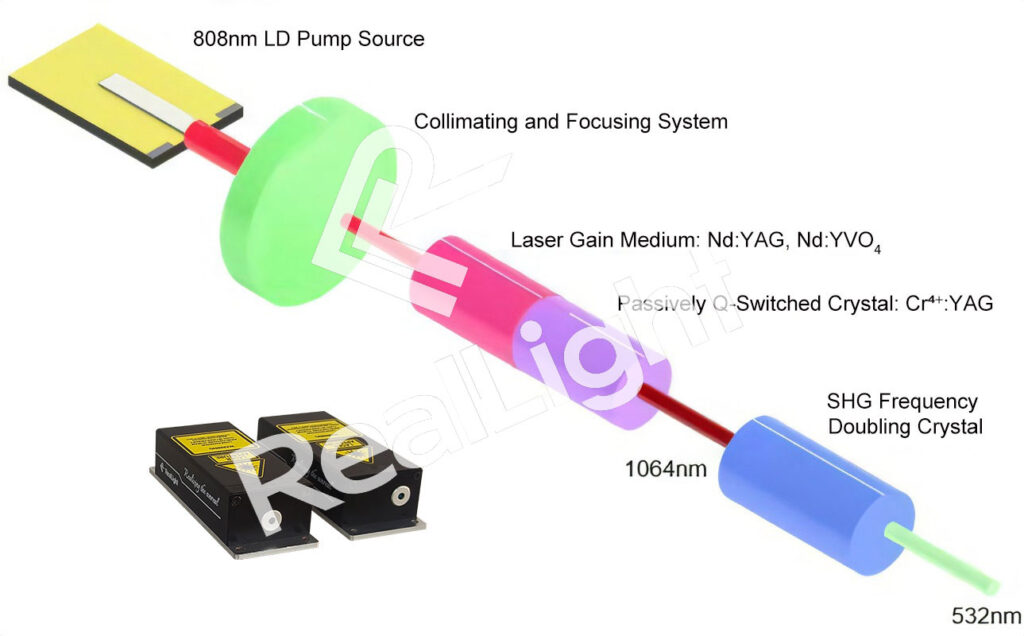
– Type: Diode-pumped, passively Q-switched solid-state microchip laser.
– Seed Source Suitability: Specifically engineered to provide low-noise, highly stable, and narrow-pulse-width initial pulses for high-power and ultrafast laser systems, serving as the “pulse origin” in amplification chains.
– Structure: Integrates the pump module and laser crystal into a fully sealed, compact unit that is easy to integrate.
II. Key Seed Source Parameters (Predominantly 1064 nm Fundamental)
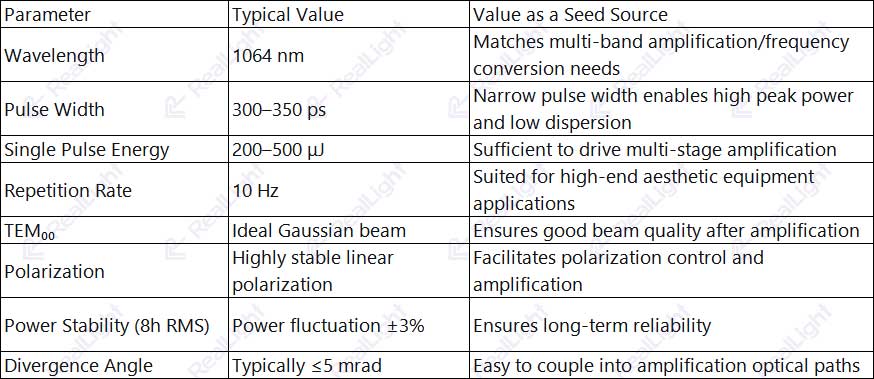
III. Core Advantages as a Seed Source
– Pure Pulse Without Tails: No trailing edges or parasitic pulses, resulting in a high signal-to-noise ratio after amplification.
– Narrow Pulse Width + High Peak Power: 300 ps-level pulse width enables MW-level peak power, ideal for picosecond/sub-nanosecond amplification chains.
– Integration-Friendly: OEM drive circuits, compact laser head, and support for internal/external triggering simplify system embedding.
– Multi-Wavelength Coverage: Fundamental plus second/third/fourth harmonics to suit various amplification and application scenarios.
– High Reliability: Fully sealed with no consumable parts, suitable for long-term industrial and research operations.
IV. Typical Application Scenarios (as a Seed Source)
– Picosecond/Sub-Nanosecond High-Power Lasers: e.g., HQF series lamp-pumped picosecond lasers directly use the MCD as the seed source.
– Lidar/Ranging: Provides narrow-pulse, high-repetition-rate seeds to improve ranging accuracy and resolution.
– Material Micro-Machining: Post-amplification for precision cutting, drilling, and scribing.
– Spectroscopy/Analysis: LIBS, LIF, Raman, etc., requiring narrow pulse width and high peak power excitation.
– Research Amplification Systems: Serves as a seed source for OPAs/OPCPAs and regenerative amplifiers.
V. Selection & Integration Considerations
– Wavelength Priority: 1064 nm is the fundamental; amplification followed by frequency conversion is more common. 532/355/266 nm can be used directly for specific band systems.
– Energy/Repetition Rate Matching: Select based on amplification gain and target repetition rate (e.g., 0.1 kHz/200 μJ suits low-repetition-rate, high-energy amplification).
– Supporting Solutions: The manufacturer provides seed source OEM driver boards, isolators, beam expanders, etc., to reduce integration difficulty.
– Triggering & Control: Supports internal/external triggering for system timing synchronization.
VI. Comparison with Competing Seed Sources
– Compared with fiber seed sources: The MCD offers narrower pulse width (300 ps vs. typical 1–10 ns), higher peak power, and no fiber nonlinear effects.
– Compared with solid-state Q-switched seed sources: The MCD is more compact, more highly integrated, delivers purer pulses, and offers better stability.
면책 조항: 이 글의 일부 내용은 인터넷에서 가져온 것입니다. 본 자료는 기술 연구 및 정보 교환 목적으로 제공되며, 참고 및 학습 목적으로만 활용하시기 바랍니다. 내용에 부정확하거나 학술적인 오류가 있을 경우 즉시 지적해 주시면 감사하겠습니다. 저작권 관련 문제가 있을 경우 저희에게 연락 주시면 확인 후 최대한 빨리 삭제하겠습니다.





 777
777