
Photoresist Repair and Microchip Laser Applications
Value and Industry Status of Photoresist Repair
In the manufacturing of semiconductor wafers, photomasks and advanced display devices, photoresist plays a critical role in pattern transfer. Throughout spin-coating, exposure and development processes, airborne particles, minor equipment jitter and process-parameter drift can give rise to micron-scale defects including photoresist residues, local bridging and micro-notches. If such defects flow into subsequent processes such as etching and vapor deposition, device failure will directly occur. Photoresist repair adopts laser-based non-contact ablation to precisely remove local defects while preserving intact photoresist layers and underlying substrates. It avoids full-panel scrapping and remanufacturing, and serves as a vital remedial process for yield improvement and production-cost control.
Not all photoresist defects are suitable for laser repair. Microchip solid-state lasers are applicable only for localized point-like or small-block micron-scale defects that require site-specific removal with strict substrate-damage control. This solution is generally not adopted for large-area photoresist spalling or extensive damage. At present, mainstream repair light sources in the industry are conventional Q-switched nanosecond DPSS lasers and ultraviolet fiber lasers. Such equipment commonly suffers from long pulse tails and prominent thermal effects, which tend to cause photoresist carbonization and substrate burning during processing. In addition, spot consistency degrades gradually over long-time operation. Meanwhile, numerous discrete optical components lead to heavy workload for commissioning and maintenance.
Featuring short pulses, high beam quality and multi-band ultraviolet output, sub-nanosecond microchip solid-state lasers have gradually emerged as a new-generation candidate light source for photoresist repair. Their 20 kHz and 30 kHz repetition rates match the scanning rhythm of automated equipment. Microchip laser products developed by Luz real also provide domestic light-source alternatives for Chinese photoresist-repair equipment manufacturers.
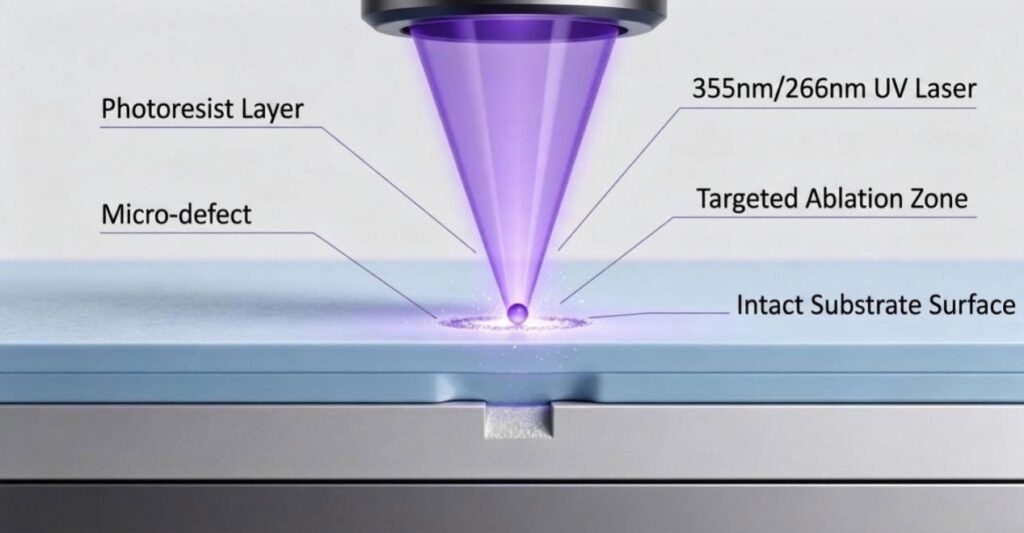
Core Process Pain Points of Laser-Based Photoresist Repair
Photoresist repair belongs to high-precision micro-area processing, imposing stringent requirements on thermal suppression, spot profile, energy stability, wavelength matching and equipment integration. Multiple typical process challenges exist in mass-production lines, and láseres de microchips deliver targeted solutions for these pain points:
2-1 Carbonization and Substrate Damage Induced by Thermal Effects
Conventional nanosecond lasers feature long pulse tails and broad thermal conduction ranges, generating black carbon residues at ablation sites and even burning underlying substrates. Microchip-based sub-nanosecond narrow-pulse lasers realize cold ablation dominated by photochemical decomposition, narrowing the heat-affected zone and curbing carbon-residue formation.
2-2 Repair-Profile Burrs Caused by Poor Beam Mode
Some traditional lasers contain high-order-mode components with uneven spot-energy distribution, resulting in jagged edges and over-etching on repaired areas, which fails the fine treatment of micro-defects. Microchip lasers deliver TEM₀₀ fundamental-mode Gaussian beams with uniform energy distribution, yielding sharp and neat repair boundaries.
2-3 Poor Processing Consistency from Pulse-Energy Jitter
Pulse-energy fluctuation may lead to incomplete photoresist removal in some regions and excessive etching with substrate damage in others, causing volatile batch yield. The integrated short-resonator-cavity structure of microchip lasers mitigates parameter drift caused by lens displacement, ensuring high single-pulse-energy stability and consistent performance during long-duration continuous processing.
2-4 Mismatch between Wavelength and Photoresist Absorption Characteristics
Infrared and green lasers mainly rely on thermal ablation and bring severe side effects. Through nonlinear frequency conversion, microchip lasers output 355 nm and 266 nm ultraviolet beams with high photon energy and high photoresist-absorption efficiency, enabling preferential photochemical decomposition.
2-5 Bulky Light-Source Structure Hindering Automation-Equipment Integration
Traditional ultraviolet solid-state lasers employ abundant discrete optical elements, which are complicated to commission and bulky in overall dimension, making them hard to embed into compact automated repair equipment. Microchip lasers adopt integrated crystal packaging with compact laser heads, supporting OEM integration and lowering optical-commissioning complexity for complete machines.
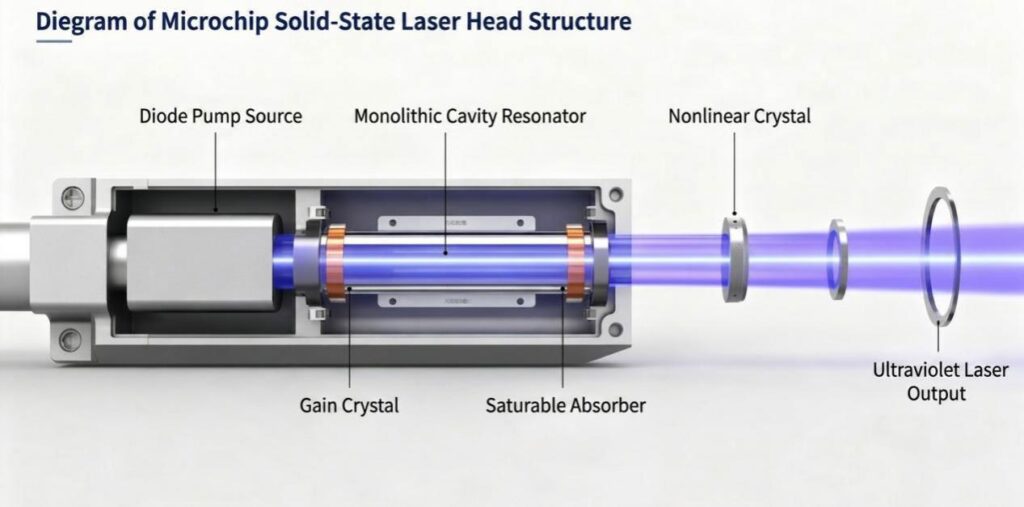
Basic Working Principle of Microchip Solid-State Lasers
láseres de microchips are diode-pumped passively Q-switched DPSS solid-state lasers built around monolithic integrated resonators. The gain crystal and saturable-absorber crystal are thermally bonded into a thin chip. Resonator reflective coatings are directly deposited on both end facets of the chip. The chip thickness itself defines the cavity length, eliminating a large number of discrete adjustable lenses and forming an ultra-simple plane-plane resonator.
End-pumping by semiconductor diodes injects pump light into the gain medium from crystal facets. The passively Q-switched effect compresses pulses to output sub-nanosecond short pulses with high peak power. Natural TEM₀₀ fundamental-mode output is achieved, with repetition rates covering the kHz range including typical 20 kHz and 30 kHz repair conditions. Coupled with second-, third- and fourth-harmonic nonlinear crystals, 355 nm and 266 nm ultraviolet laser outputs can be obtained. The entire optical path is pre-aligned at factory, requiring no repeated on-site adjustment, and inherently satisfies micro-area high-precision processing requirements for photoresist repair.
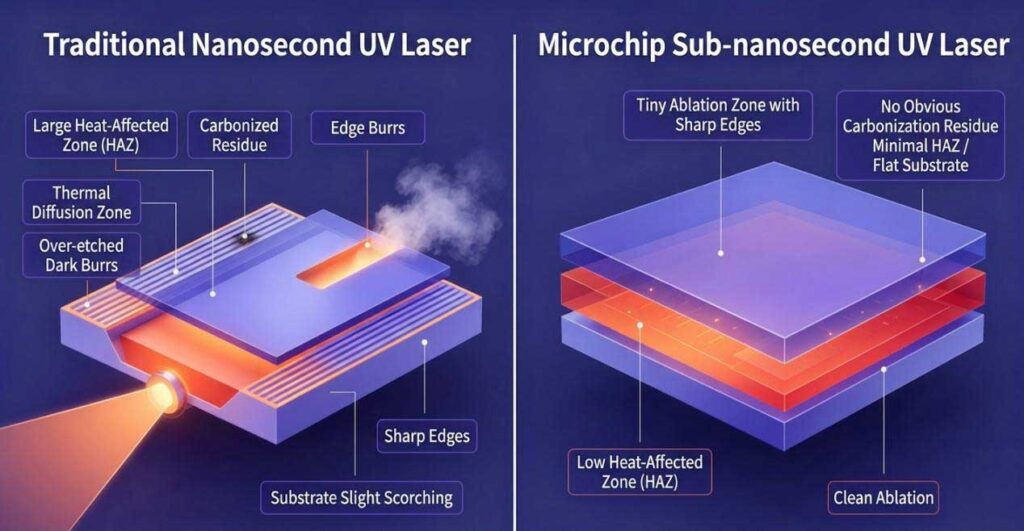
Core Advantages of Microchip Lasers for Photoresist Repair
Structural features of láseres de microchips translate into practical process merits, well matching real-world requirements of photoresist repair for high precision, low thermal damage and mass-production compatibility. This accounts for their rapid adoption in fine-repair scenarios.
First, sub-nanosecond short pulses enable low-damage cold processing. Sub-nanosecond pulses ranging from several hundred picoseconds to 1-2 ns release energy instantaneously. Photoresist is primarily removed via photochemical dissociation and volatilization. Heat cannot diffuse to adjacent intact photoresist or underlying substrates, confining the heat-affected region to an extremely small scale. This reduces substrate oxidation and burning, suppresses carbon residues and eases post-repair cleaning workload. Luz real’s microchip light sources exhibit clean waveforms without obvious pulse tails, effectively avoiding thermally induced processing defects during site-specific removal of tiny photoresist defects.
Second, TEM₀₀ fundamental-mode beams guarantee micron-scale contour precision. The short integrated resonator inherently suppresses high-order oscillation modes and delivers pure Gaussian beams that can be focused into compact, well-defined spots. For photoresist defects of several to tens of micrometers, ablation zones can be precisely confined with sharp repair edges, free of irregular over-etching and burrs. It meets high-precision repair specifications for photomasks and wafer devices — a performance difficult for many ordinary fiber lasers to achieve.
Third, high pulse-energy stability supports continuous industrial mass production. With resonators integrated inside bonded crystal chips, risks of discrete-lens vibration and displacement are eliminated and pulse-energy jitter is minimized. Stable operation at high repetition rates of 20 kHz and 30 kHz ensures consistent output for every pulse, uniform repair results for large-batch workpieces, reduced compensation demands for vision positioning and motion stages, and stable production-line yield.
Fourth, dual ultraviolet bands flexibly adapt to diverse photoresist materials. After frequency conversion, microchip solid-state lasers deliver 355 nm and 266 nm ultraviolet outputs. The 355 nm band offers superior versatility for site-specific repair of most conventional photoresists. The 266 nm band provides higher-energy photons for enhanced photochemical-ablation efficiency against certain UV-resistant and thick-film photoresists. Process engineers can select bands flexibly according to photoresist formulation and film thickness.
Fifth, compact hermetic structure facilitates equipment integration. Diode-pumped DPSS microchip laser heads feature compact layout and fully sealed optical paths, resisting dust and ambient-temperature fluctuation. Supporting external triggering, they can interface directly with machine-vision systems and high-precision motion platforms, enabling equipment vendors to develop compact complete photoresist-repair systems. Modular light-source solutions from Luz real effectively shorten development cycles for domestic equipment manufacturers.
Nevertheless, láseres de microchips have inherent limitations. Constrained by physical properties of passively Q-switched microchip crystals, maximum single-pulse energy is limited. They are more suitable for localized site-specific repair rather than large-area full photoresist stripping. Average-power scaling becomes challenging under ultra-high repetition rates, calling for parameter trade-offs according to practical processes.
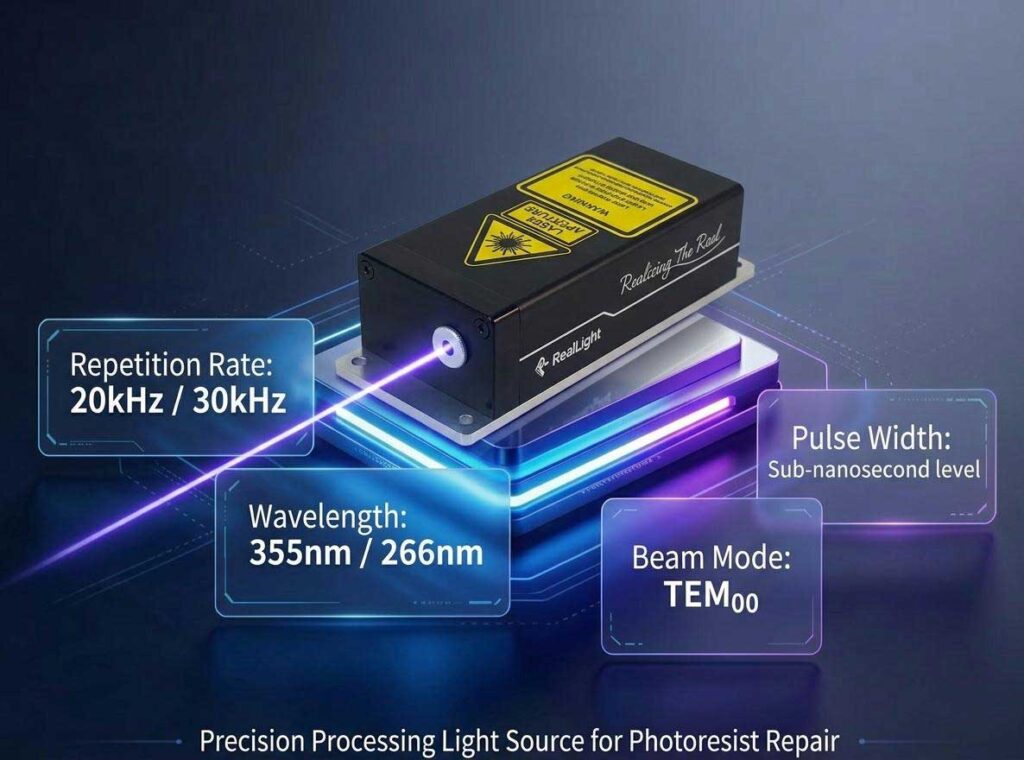
Summary and Outlook
Photoresist repair constitutes an essential link for yield assurance and cost reduction in microelectronics manufacturing. Drawbacks of traditional nanosecond light sources, including severe thermal side effects and tedious commissioning, become increasingly prominent amid growing demands for finer micro-defect repair. DPSS Diode-pumped sub-nanosecond láseres de estado sólido de microchips, with integrated microchip resonators delivering sub-nanosecond pulse width, high-quality TEM₀₀ beams, industrial-grade 20 kHz-30 kHz repetition rates and optional 355 nm / 266 nm ultraviolet bands, fill part of the light-source gap for high-precision site-specific photoresist repair.
Driven by sustained growth of China’s semiconductor and high-end display industries, domestic demand for home-grown repair equipment keeps rising. Domestic laser manufacturers represented by Luz real continuously iterate microchip-laser products to advance localization of ultraviolet microchip light sources. Future industry trends will target higher repetition rates and higher ultraviolet average power to further boost repair throughput. Meanwhile, comprehensive process-parameter databases will be built for various photoresist types and substrate materials.
Furthermore, microchip lasers will be deeply integrated with high-definition visual inspection and high-precision motion-control systems to realize full-process automation of “defect detection-positioning-laser-repair-re-inspection”. With continuous performance optimization of microchip lasers, the precision, efficiency and stability of laser-based photoresist repair will be further improved, providing solid light-source support for cost reduction and efficiency gain in China’s high-end micro-manufacturing industry.
Descargo de responsabilidad: Parte del contenido de este artículo proviene de internet con fines de investigación e intercambio técnico. Su propósito es meramente informativo y educativo. Si encuentra alguna inexactitud o discrepancia académica, le agradecemos que nos lo comunique. Para cualquier problema relacionado con los derechos de autor, contáctenos y verificaremos y eliminaremos de inmediato cualquier contenido que los infrinja.





 777
777