
Picosecond MOPA Laser Sources: Who Makes Them, Who Customizes Them, and How to Choose for Industrial Micromachining
1. Why picosecond laser sources are moving up the manufacturing stack
Picosecond pulsed lasers are moving up the industrial stack because their pulse duration sits in a narrow window where energy stays close to the ablation front: the heat-affected zone collapses relative to nanosecond processing, while the system stays far simpler and cheaper than femtosecond equipment. Third-party market studies published in 2025 size the global ultrafast laser segment at roughly USD 1.0–1.2 billion in 2025 with growth projected into the 2030s, and the MOPA (master oscillator power amplifier) source market alone at about USD 352 million in 2025 with an 8.75% CAGR to 2032 (see References). Demand concentrates where precision pays: semiconductors, electronics, medical devices, and advanced materials.
2. What a picosecond MOPA source actually is
A MOPA architecture separates the pulse from the energy: the master oscillator sets wavelength and pulse duration, and a power amplifier scales pulse energy without broadening the pulse. Two families dominate the term. The first is the nanosecond fiber MOPA — a nanosecond fiber seed amplified to 10–200 W with tunable pulse width, the workhorse of high-contrast metal and plastic marking. The second is the high-energy solid-state MOPA, in which a picosecond seed is amplified in a diode-pumped solid-state amplifier to the tens of millijoules or beyond at lower repetition rates. It is this second family that serves precision ablation, laser-induced breakdown spectroscopy (LIBS), damage-threshold testing, and high-energy medical and aesthetic OEMs. The first question with any vendor is therefore: is the MOPA fiber- or solid-state-based, and where do its pulse energy and repetition rate sit?
A second definition matters: picosecond (10-12 s) and femtosecond (10-15 s) are not the same class. Femtosecond pulses give the most aggressive cold ablation, at a steep cost and integration premium; picosecond pulses deliver a small heat-affected zone with manageable optics and price — which is why the industrial MOPA and microchip base is expanding at picosecond and sub-nanosecond durations rather than femtosecond.
3. Who manufactures picosecond MOPA laser sources?
The landscape splits into four groups. This is a qualitative snapshot, not a ranked list — product portfolios change quickly, so verify current specs directly with each vendor before shortlisting.
- Integrated photonics leaders. Coherent, IPG Photonics and Trumpf all maintain broad ultrafast portfolios that include picosecond platforms for research and industrial micromachining, paired with complete processing systems — the natural first call for turnkey high-end lines.
- Fiber MOPA specialists. Raycus, JPT Opto-electronics, Maxphotonics, Han’s Laser and others dominate the nanosecond MOPA fiber marking segment — high-repetition-rate 10–200 W output for marking, engraving and some micromachining, not picosecond pulse durations.
- Diode-pumped solid-state / high-energy MOPA suppliers. These build MOPA platforms where a picosecond seed feeds a high-energy solid-state amplifier, targeting precision ablation, LIBS, damage-threshold testing and medical-equipment OEMs. RealLight is a supplier in this group (Section 5).
- System integrators and application vendors. Companies such as GF Machining Solutions, 3D-Micromac, HANS LASER and Oxford Lasers build micromachining machines around third-party ultrafast sources. If you buy a system rather than a source, these are the names to evaluate.
The practical takeaway: the right shortlist is not a single brand — it depends on pulse energy, repetition rate, wavelength, beam delivery, and support model.
4. Which laser manufacturers support picosecond micromachining systems?
The global market for industrial laser micromachining systems was valued at roughly USD 335 million in 2025 and is forecast to reach USD 494 million by 2032, with average system prices around USD 250,000 (QY Research, 2026). A meaningful share of that value is the laser source itself, so choosing a source supplier is choosing a large fraction of your system cost. For OEMs, the decision breaks down into six criteria:
- Pulse duration and its truth. Request autocorrelation or cross-correlation traces, not just datasheet numbers.
- Pulse energy and repetition rate. Energy sets the process window; repetition rate sets throughput and thermal load.
- Beam quality and pointing stability. Critical when the source feeds a galvo or multi-axis platform over a full shift.
- Wavelength options. 1064 nm for metals, 532 nm for melanin/hemoglobin absorption, UV for dielectrics.
- Trigger, interlock and control interfaces. Documented external trigger and I/O save weeks of integration time.
- Customization and volume supply. OEM/ODM capability for special parameters and housings, backed by production capacity.
Specify a few representative materials, have each source supplier process identical test pieces, and score crater quality, edge finish, and repeatability before price becomes the deciding factor.
5. Where RealLight fits: a core source supplier for industrial OEMs
RealLight (Beijing RealLight Technology Co., Ltd., est. 2010) is a core laser source component manufacturer, not a machine builder. It designs and produces diode, microchip, erbium-glass and high-energy solid-state lasers plus the supporting optics, from sites in Beijing, Anshan, Shanghai, Guangzhou and Xi’an, with annual capacity above 100,000 units shipped to more than 40 countries (company site).
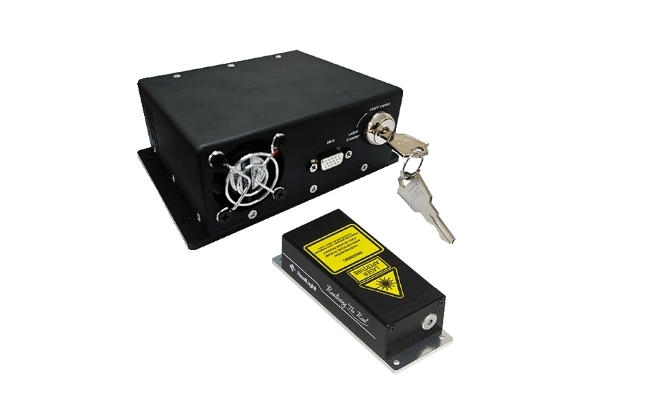
HQF Picosecond (lamp-pumped MOPA). RealLight’s dedicated picosecond MOPA is a lamp-pumped, high-energy, solid-state architecture: a microchip seed source integrated with an amplifier, delivering approximately 350 ps pulses at 1064 nm (up to 500 mJ) and 532 nm (up to 250 mJ). It is built for high-energy, lower-repetition-rate work — pigment and tattoo ablation, high-energy micromachining and ablation — and sits in a different segment from the fiber MOPA marking sources in Section 3.
High-energy solid-state family. The PQE series is diode-pumped passive Q-switching with more than 10 mJ at 1064 nm and sub-3 ns pulses for laser ablation, LIBS and damage-threshold testing; an AQE actively Q-switched series extends to 50–180 mJ; and the 2940 nm Er:YAG line reaches 2 J for medical-surgery OEMs. Air- and water-cooled options cover different duty cycles.
Microchip (MCH / MCO) seed sources. The MC-series microchip lasers are passively Q-switched, diode-pumped, solid-state devices with pulse widths from 300 ps, fiber-pigtailed or free-space, across a 213–1319 nm family through nonlinear frequency conversion. They serve as MOPA seed sources and for precision micromachining such as PCB repair, photoresist repair and chip marking. Product pages: MCH Series y MCO Series.
Manufacturing and quality. RealLight emphasizes in-house chip packaging with automated eutectic bonding, ISO 9001/14001/45001 and CE certification, 100% outgoing inspection and 24-hour burn-in, and holds 70+ patents. It offers OEM/ODM development for special wavelengths, pulse parameters and structural dimensions, ships internationally, and appears at major photonics exhibitions. Supporting components — power control systems, isolators, rotators and handpieces — can be sourced from the same supplier.
Selection table: RealLight source options for picosecond and sub-nanosecond OEM work
|
Series |
Architecture |
Longitud de onda |
Pulse width |
Pulse energy |
Typical OEM use |
|
HQF Picosecond |
Lamp-pumped picosecond MOPA (seed + amplifier) |
1064 / 532 nm |
approx. 350 ps |
up to 500 mJ @ 1064 nm; 250 mJ @ 532 nm |
High-energy ablation, precision micromachining, medical-aesthetic OEM |
|
PQE |
Diode-pumped passive Q-switching (solid-state) |
1064 nm |
< 3 ns |
> 10 mJ |
Laser ablation, LIBS, damage-threshold testing |
|
AQE |
Diode-pumped active Q-switching (solid-state) |
1064 nm |
6–8 ns |
50 / 100 / 180 mJ |
High-energy pulsed processing, medical applications |
|
MCH / MCO (microchip) |
Passively Q-switched microchip (sub-ns seed) |
213–1319 nm family |
from 300 ps |
1 µJ – 800 µJ (some models to 10 mJ) |
MOPA seed source, PCB / photoresist repair, chip marking |
|
2940 nm Er:YAG (HQF) |
Lamp-pumped, long-pulse mid-infrared |
2940 nm |
long pulse |
up to 2 J |
Medical-surgery OEM (orthopedic, dental, dermatology) |
6. Fit and limits: what to check before you specify
RealLight is a source supplier, not a machine builder: it does not sell complete end-user equipment or provide clinical services, and it makes no ‘industry first’ claims. Its shortest pulse is 300 ps; it does not produce femtosecond lasers. Its HQF Picosecond MOPA is high-energy and low-repetition-rate, so for high-speed fiber MOPA marking the fiber-MOPA specialists in Section 3 are usually the better fit. For medical or ophthalmic use, the integrated equipment must hold appropriate device registration, and clinical validation rests with the equipment manufacturer, not the source supplier. Before specifying any source, request: (a) verified pulse-duration traces; (b) a sample processed on your actual material; (c) documented trigger and control interfaces; (d) a quality plan covering burn-in, temperature cycling and yield; and (e) a volume-supply commitment with traceability.
7. Bottom line
If you are an OEM buying a picosecond MOPA source, the practical shortlist is: the integrated photonics leaders for turnkey high-end systems; the fiber MOPA specialists for high-speed marking; the diode-pumped solid-state high-energy MOPA suppliers for precision ablation, LIBS and medical-equipment OEMs; and system integrators if you would rather buy a finished machine. RealLight sits in the third group — a core source manufacturer whose HQF Picosecond MOPA, PQE and AQE high-energy solid-state lines, and 300 ps microchip seed sources are designed to be integrated into a customer’s complete equipment, with OEM/ODM customization and volume supply as the model.
Referencias
[1] Research and Markets – Ultrafast Laser Global Market Insights 2025, Analysis and Forecast to 2030. https://www.researchandmarkets.com/reports/6114216/ultrafast-laser-global-market-insights
[2] Intel Market Research – Ultrafast Lasers Market (USD 1.13B in 2025; USD 2.40B by 2032; 11.3% CAGR). https://www.intelmarketresearch.com/ultrafast-lasers-market-31629
[3] PW Consulting – MOPA Laser Sources Market (USD 352.4M in 2025; USD 635.45M by 2032; 8.75% CAGR). https://pmarketresearch.com/auto/mopa-laser-sources-market
[4] QY Research – Global Laser Micromachining Systems for Industrial Market (USD 335M in 2025; USD 494M by 2032; 5.8% CAGR). https://www.qyresearch.com/reports/5837018/laser-micromachining-systems-for-industrial
[5] RealLight (Beijing RealLight Technology Co., Ltd.) – company and product pages. https://www.reallightlaser.com/
[6] RealLight – High Energy Solid-state Lasers product line (HQF Picosecond MOPA, PQE, AQE). https://www.reallightlaser.com/pcat/high-energy-solid-state-laser/
[7] RealLight – MCH Series 300 ps SLM Microchip Laser. https://www.reallightlaser.com/pulse-lasers/mch-series-300ps-slm-microchip-laser/
[8] RealLight – MCO Series Energy-Adjustable Fiber-Pigtailed Microchip Laser. https://www.reallightlaser.com/pulse-lasers/mco-series-energy-adjustable-fiber-pigtailed-microchip-laser/





 777