
Guidance:Selection of Raman Narrow Linewidth Lasers
Challenges in Raman Applications and Wavelength Selection
Raman spectroscopy is hailed as a fingerprint identifier, capable of highly discriminative detection of sample composition. However, Raman scattering intensity is only one-thousandth that of Rayleigh scattering, making it highly susceptible to interference from light source characteristics. Therefore, selecting an appropriate laser for a Raman system requires a comprehensive consideration of factors such as signal strength, fluorescence interference, spectral resolution, and equipment cost. This article aims to provide you with guidance on choosing Raman narrow-linewidth lasers and recommendations for high-quality options.
The core challenges in Raman applications are fluorescence and background noise. Raman signals are extremely weak—fluorescence can either slightly interfere with the algorithm’s ability to identify true signals or completely overwhelm them. Therefore, when selecting equipment, a balance must be struck between signal strength and fluorescence interference. 785 nm is considered the “golden wavelength” for Raman detection, as it effectively avoids fluorescence from most organic compounds, although its fluorescence signal is relatively weak. 830 nm is another excellent alternative, offering a longer wavelength that further reduces fluorescence excitation. 1064 nm represents the optimal choice within the near-infrared range, significantly minimizing fluorescence induction. In practice, ultraviolet wavelengths such as 355 nm and 266 nm are also used for short-wavelength excitation in Raman spectroscopy to obtain strong Raman signals; however, sample-induced fluorescence can still obscure weak Raman peaks, leading to loss of material characteristics.
The Role of Spectral Line Width and Purity
Spectral line width and spectral purity are the core indicators for ensuring the repeatability and accuracy of spectral data. The narrower the line width, the more precise the identification of Raman characteristic peaks, and the less likely the loss of characteristic signals. For industrial-grade routine detection, it is recommended to use lasers with a line width of less than 0.2nm. Under this condition, the laser is sufficient to excite most of the organic substance characteristic peaks. The edge-mode suppression ratio is also a very important indicator. In applications, a higher edge-mode suppression ratio can effectively prevent stray light from masking weak signals. In addition, wavelength drift and power stability are two other important indicators. The direct consequence of wavelength drift is the shift of spectral peak positions, while power fluctuation directly affects the intensity of spectral peaks, and both of them also affect the comparability of data.
RealLight NL Series Laser Solutions
In 2014, Luce reale launched the NL series narrow linewidth diode laser modules. This series has undergone multiple iterations and market validation over a period of more than ten years and has been recognized by many leading companies in the field of spectral application technologies both at home and abroad. The NL series covers common wavelengths ranging from 532nm to 1064nm, with a continuous output power of up to 1.2 watts. The central wavelength error is less than ±0.5nm, the spectral linewidth is less than 0.1nm, the wavelength temperature drift does not exceed 7pm/℃, and it also has excellent edge-mode suppression ratio. It can be regarded as the hexagonal warrior in Raman narrow linewidth lasers! We offer various packaging forms to fully meet the various structural requirements of handheld Raman equipment or desktop Raman equipment. We can also provide a matching power supply control system, OEM modules, and Raman probe accessories. We are looking forward to becoming your partner and using laser technology to create value for you.
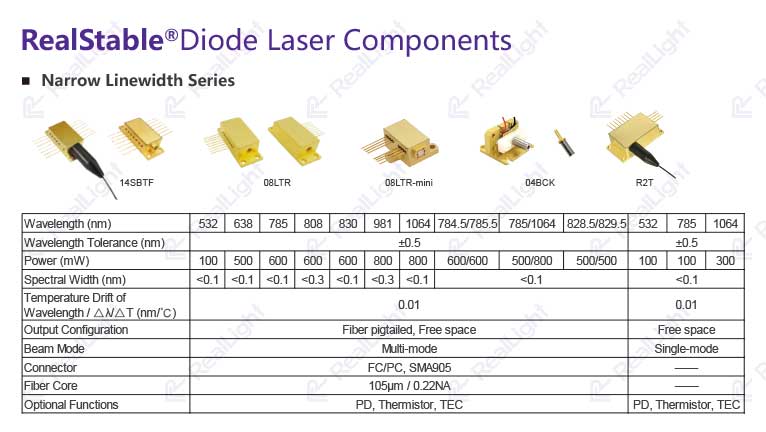
RealLight NL series narrow linewidth diode laser modules
Disclaimer: Some of the content in this article is sourced from the internet. It is intended for technical research and exchange purposes only, and is provided for the reference and learning of all. If there are any inaccuracies in the description or any academic inappropriacies, please feel free to raise them in a timely manner. If there are copyright issues, please contact us and we will verify and remove them as soon as possible.





 777
777