
Eye-Safe 1535nm Laser Modules for Long-Range LiDAR
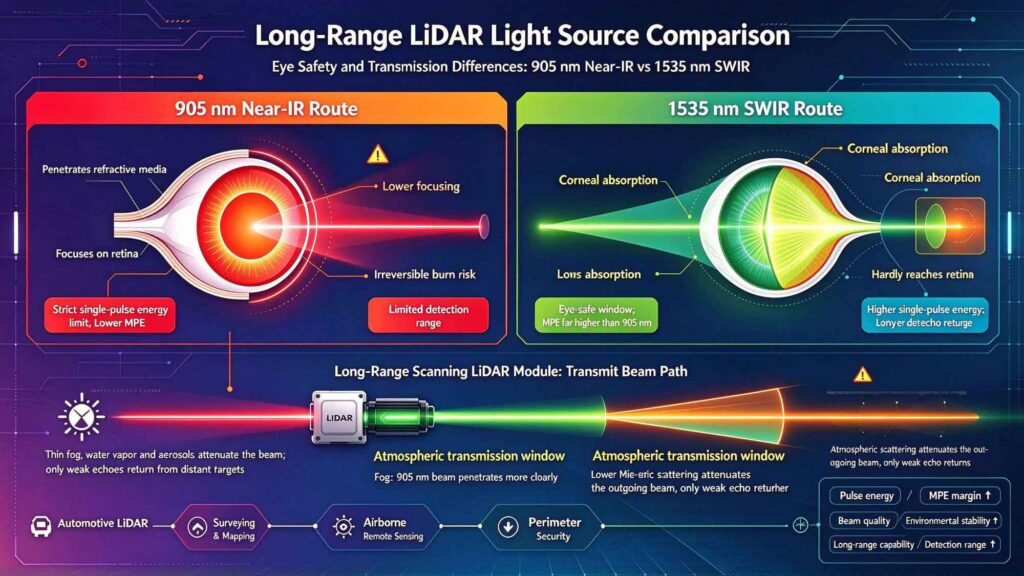
Long-range LiDAR calculates target distance based on the Time-of-Flight (ToF) principle. The safety class, pulse energy, pulse width, beam quality and environmental stability of the laser source directly determine the maximum detection range, ranging accuracy and compliance of the radar system. Currently, 905nm and 1535nm are two mainstream technical routes for automotive, surveying and airborne long-range LiDAR, with distinct mechanisms of eye injury. The refractive media of human eyes have different transmittance characteristics for infrared light of different wavelengths: 905nm near-infrared light can penetrate the cornea and lens and focus on the retinal photoreceptor layer, and even tiny energy may cause irreversible retinal burns. Laser safety standards impose strict limits on its single-pulse energy, which restricts the detection range. In contrast, 1535nm falls into the short-wave infrared eye-safe window. Photons at this wavelength are mainly absorbed by the cornea and lens and hardly reach the retina. Its maximum permissible exposure (MPE) is much higher than that of 905nm. While complying with IEC 60825 laser safety standards, it can deliver higher single-pulse energy for longer detection range. In addition, 1535nm is located in an atmospheric transmission window, with lower Mie scattering loss in fog, haze and water vapor. It achieves better echo signal-to-noise ratio under poor visibility conditions, making it the preferred light source for long-range scanning LiDAR, long-distance single-point rangefinders, UAV remote sensing and perimeter security radar.
The 1535nm lasers developed by RealLight adopt Er:glass passively Q-switched architecture as the core. Passive Q-switching realizes self-modulation of intracavity loss by a saturable absorber: the pump light continuously excites the erbium glass gain medium, Er³⁺ ions transition from the ground state to high energy levels and accumulate population inversion gradually. When the intracavity photon density reaches the threshold, the saturable absorber is rapidly bleached, the intracavity loss drops instantly, and the stored energy is released within an extremely short time to form narrow laser pulses. Compared with active Q-switching solutions, passive Q-switching features simple structure and no high-voltage driving, which is naturally suitable for miniaturized LiDAR modules. Combined with the microchip configuration, the resonant cavity length is further shortened to obtain clean nanosecond pulses with little waveform tailing, which helps reduce the timing error of ToF ranging.
Leveraging this mature Er:glass passively Q-switched technology, RealLight has independently developed a full lineup of 1535 nm eye-safe laser modules. The portfolio covers multiple product lines including high-repetition-rate low-energy, medium-energy, high-energy variants and integrated transmitting antenna modules, catering to ranging requirements and radar architectures of different detection ranges.
Among them, the RealSubns® high-repetition-rate 1535 nm erbium glass laser features a repetition rate of 1–5 kHz, single pulse energy of 10–40 μJ, pulse width of 5–8 ns, and TEM₀₀ fundamental-mode output. A built-in PIN photodetector delivers synchronous trigger signals. With compact dimensions of 25×8×7 mm and a weight of approximately 10 g, it is ideal for medium-to-long-range scanning LiDAR and multi-point obstacle-avoidance radar.
The medium-to-high-energy microchip series offers single pulse energy from 500 μJ to 2mJ with pulse energy stability RMS ≤ 3% and excellent beam quality, designed for several-kilometer long-range single-point ranging radar. For ultra-long-distance ranging applications, RealLight provides high-energy erbium glass lasers achieving 5–8 mJ single pulse energy, featuring clean pulse profiles without tailing and superior beam quality.
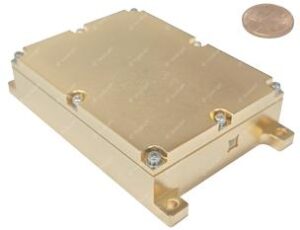
1535nm 5-8mJ Er:glass laser photo
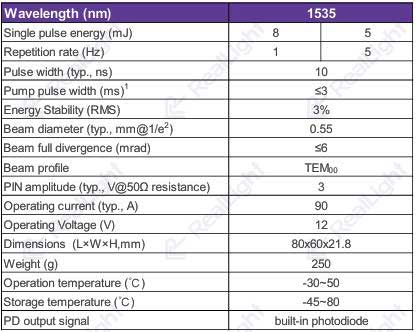
1535nm 5-8mJ Er:glass laser table
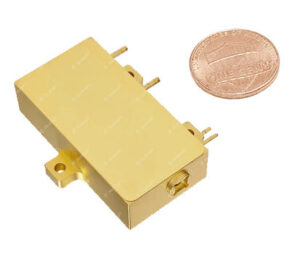
1535nm 1.5-2 mJ Er:glass laser photo
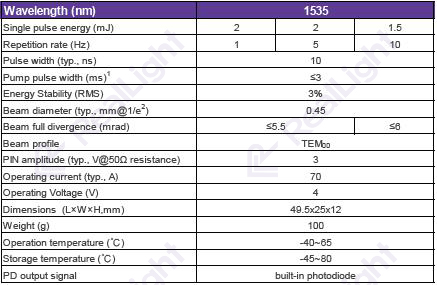
1535nm 1.5-2 mJ Er:glass laser table
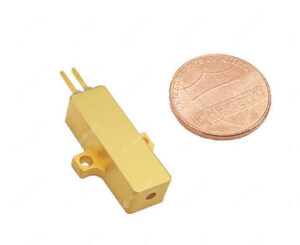
1535nm High Repetition Er:glass laser photo
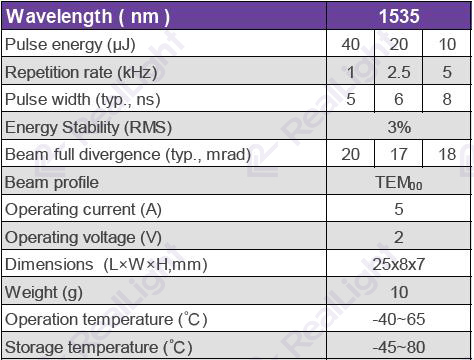
1535nm High Repetition Er:glass laser table
The supporting T01, T02 and T03 integrated laser transmitting antenna modules integrate the laser, transmitting antenna and PD monitoring unit. They achieve an optical transmittance above 90% with a controllable divergence angle within 0.8 mrad. Optical coupling and calibration are completed at factory, which greatly reduces the optical tuning workload for downstream system manufacturers. They serve as proven plug-and-play transmitting submodules.
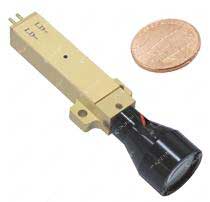
T03 Series Eye-safe Laser Transmitter photo
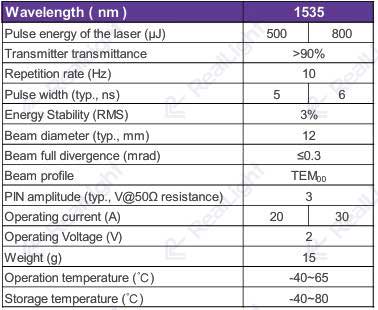
T03 Series Eye-safe Laser Transmitter table
All products can work stably from -40 ℃ to 65 ℃, adopting hermetically sealed integrated semiconductor pumping packaging. The pump source excites the gain medium steadily, and the built-in temperature control design suppresses drift of wavelength and pulse energy against temperature change. The pulse waveform is clean without tailing. Compared with near-infrared bands, 1535nm has better atmospheric penetration in low-visibility conditions such as rain, fog and haze. Balancing safety, detection range and environmental robustness, these modules have been widely applied in automotive long-range LiDAR, surveying LiDAR, security rangefinders and airborne remote sensing.
RealLight 1535nm Er:glass Passively Q-switched Laser adopts an in-house developed simplified resonant cavity structure. Combined with mass assembly on automated production lines and automated burn-in testing, it greatly reduces the cost of manual alignment. With domestically sourced core components and a controllable supply chain, it enables large-scale low-cost delivery while guaranteeing consistent pulse energy and beam consistency. The annual production capacity exceeds 100,000 units.
Disclaimer: Part of the content in this article is sourced from the Internet. It is intended solely for technical research and exchange and is for reference and learning only. Please feel free to notify us if you find any inaccurate or academically incorrect descriptions. If any copyright issue is involved, please contact us, and we will verify and remove the relevant content as soon as possible.
Q&A
Q1: Why is 1535nm laser more suitable for long-range LiDAR, and what is its core advantage over 905nm?
A: From the perspective of optical mechanism, 1535nm is an eye-safe wavelength. Laser energy is mainly absorbed by the cornea and lens instead of focusing on and damaging the retina. It has a higher maximum permissible exposure (MPE), so higher pulse energy can be used to achieve longer detection range. Besides, it lies in an atmospheric transmission window and suffers less scattering loss in fog and haze, delivering better signal-to-noise ratio for long-distance detection than 905nm. 905nm light can reach the retina directly, so safety regulations strictly limit output power and inherently cap the maximum ranging distance.
Q2: RealLight’s 1535nm erbium glass laser adopts passive Q-switching. What are the advantages of this scheme?
A: Passive Q-switching relies on the intracavity saturable absorber for automatic pulse modulation. It does not require Pockels cells, high-voltage drive circuits and other components needed for active Q-switching. The resonant cavity has a simple and compact structure, which is easy for miniaturization. It features low power consumption and high reliability, with stable pulse timing and narrow nanosecond output pulses. The small pulse tail reduces ToF ranging timing error. Moreover, the gain characteristics of erbium glass match the 1535nm band well, which fits the requirements of eye-safe long-range LiDAR. Equipped with a built-in PIN detector, it synchronously captures the light-emitting signal to provide a time reference for ranging.
Disclaimer: Part of the content in this document is sourced online, intended solely for technical-research exchange and reference purposes. Feedback is welcome for factual or academic errors. Should any copyright concerns arise, please contact us for prompt verification and removal.
参考文献





 777