
Application of Nanosecond Laser in LIBS
Laser induced breakdown spectroscopy (LIBS) is an in-situ, rapid, multi-element synchronous detection atomic emission analysis technique, and its performance largely depends on the excitation light source. Nanosecond lasers have become the most mature and popular core component of LIBS systems due to their high peak power, compact structure, wavelength selectivity, and high repetition rate. Its core characteristics are as follows.
Wavelength: Common wavelengths include 1064nm, 532nm, 355nm, etc. 1064nm wavelength lasers are widely used, but some samples may have better absorption of specific wavelengths of laser. In this case, it may be necessary to choose other wavelengths, such as 532nm, 355nm, etc. generated by frequency doubling crystals.
Pulse energy: The higher the pulse energy, the more effectively it can vaporize and ionize the sample, generating stronger plasma signals. Generally speaking, the pulse energy in LIBS applications can be selected between tens of mJ and hundreds of mJ.
Repetition rate: The Repetition rate determines the number of laser pulses per unit time. A higher Repetition rate can improve the analysis speed, but it may also cause the sample surface to overheat, affecting the analysis results. The common Repetition rate range is from a few Hz to several hundred Hz.
Pulse duration: A shorter pulse duration can generate higher peak power, thereby enhancing interaction with the sample and facilitating LIBS analysis. Generally, nanosecond lasers with pulse durations of around 3-10ns are chosen.
Beam quality: Good beam quality, such as low divergence beams, can better focus the laser on the sample surface, improve energy utilization and analysis accuracy.
Stability: The long-term stability of lasers is crucial for LIBS applications, as it directly affects the repeatability and reliability of analysis results. A laser with stable output power and energy should be selected, such as some lasers designed with diode pumping, which have good stability and longer service life.
Ⅰ、 Working principle of LIBS
LIBS uses focused high-energy pulsed laser to instantly ablate micrometer sized substances on the surface of the sample, forming a plasma with a temperature of up to 10 ⁴ K; During plasma cooling, characteristic spectral lines of elements are emitted, which are collected and analyzed by a wideband spectrometer for qualitative or quantitative analysis. The peak power of nanosecond lasers (typical Nd: YAG, pulse width 5-10 ns, single pulse energy 10-200 mJ) can reach the megawatt level, which is sufficient to stably excite plasma on metals, minerals, soils, liquids, and even biological samples. It is the preferred light source for LIBS industrialization.
In response to the domestic integration demand for handheld and portable LIBS devices, RealLight has independently developed the PQE series high-energy solid-state laser, which is specifically designed for LIBS and laser ablation. This model PQE-1064-0.01-10 perfectly matches the core specifications of LIBS light source: 1064nm infrared wavelength, 10Hz repetition rate, single pulse energy>10mJ, pulse width<3ns, narrow pulse width combined with ten millijoules energy output can achieve ultra-high peak power, which can efficiently ionize various solid samples such as ore, alloy, soil, etc. without the need for additional energy amplification modules, greatly simplifying the overall optical path structure of LIBS.
Ⅱ、 LIBS system configuration
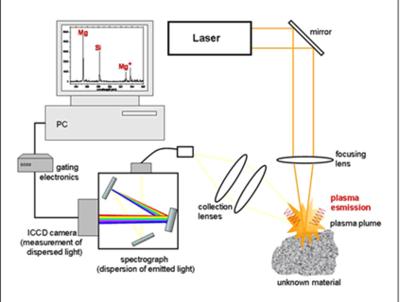
A typical nanosecond LIBS device consists of four parts:
1. Laser head and power supply: Provides 532/355/266 nm output at 1064 nm fundamental frequency or frequency doubling, with a repetition rate of 10-100 Hz, and can be triggered externally.
The recommended domestic portable solution is the RealLight PQE series solid-state laser, which adopts a semiconductor pump crystal integrated microchip optical path. The laser head size is only 83 × 30 × 22.1mm, and it is matched with a control board of 45 × 39.6 × 110.3mm. The split structure is easy to embed into handheld probes and field testing cases; The whole machine is powered by 12VDC low voltage, with a maximum power consumption of only 20W, and is suitable for portable devices powered by lithium batteries; The control interface is equipped with RS-232 serial port and multi-channel I/O, supporting internal and external dual trigger modes, and can seamlessly interface with timing synchronization modules and spectral acquisition systems, greatly reducing the difficulty of secondary development and integration for equipment manufacturers. The equipment is purely air-cooled for heat dissipation, abandoning traditional high-energy laser water-cooled units and eliminating the need for water pipes and refrigeration equipment. The system construction is minimalist and suitable for outdoor and vehicle mounted water free working conditions.
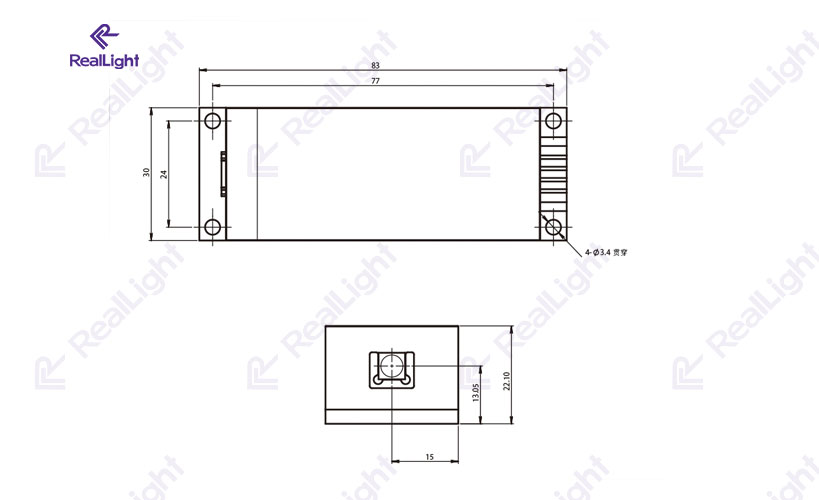
Mechanical dimension diagram of PQE series high-energy solid-state laser
2. Optical path and focusing: Quartz lenses focus the laser beam onto the surface of the sample, with a focal power density greater than 1 GW cm ²; coaxial or off-axis collection lenses couple plasma light into the fiber.
The horizontal and vertical 1/e ² full angle divergence angles of the PQE laser beam are both 3mrad, with excellent beam convergence and precise focusing point position, reducing experimental errors in LIBS spectral acquisition; The RMS fluctuation of energy is less than 3%, and the consistency of pulse energy during long-term continuous sampling is high, ensuring stable and reproducible data from multiple on-site inspections.
3. Timing control: The digital pulse generator synchronizes the laser Q-switch with the spectrometer gate to suppress continuous background and improve signal-to-noise ratio.
4. Spectral detection: A multi-channel Czerny Turner spectrometer (200-850 nm, resolution 0.1 nm) is used in conjunction with gate controlled ICCD/CMOS to achieve millisecond level full spectrum acquisition.
The entire system can be integrated into handheld platforms weighing less than 5 kg, and can also be expanded into online probes to adapt to complex working conditions in industrial sites. As shown in the figure below:
The PQE series has the ability to adapt to a wide temperature range, with a standard working temperature of 10-35 ℃ and a storage tolerance of -20~60 ℃. It can withstand high and low temperatures for long-term outdoor and vehicle use without any deviation in the optical path, ensuring stable detection of LIBS 24/7.
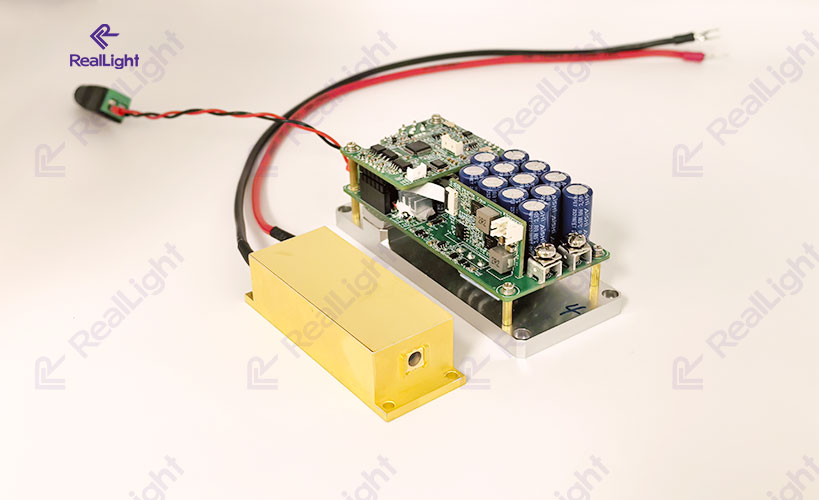
PQE series high-energy solid-state laser
Ⅲ、 The advantages of nanosecond lasers in LIBS
1. High peak power, plasma stability
The combination of nanosecond pulse width and millijoule level energy can form high-temperature, high electron density plasmas on any solid surface, with high signal-to-noise ratio and trace element detection limits as low as ppm. The pulse width of RealLight PQE series is controlled within 3ns, with a single pulse energy of>10mJ, outstanding peak power, and low heat affected zone ablation. It can stably excite strong plasma signals and accurately control the sample ablation range, meeting the requirements of high sensitivity and micro loss detection.
2. Multi wavelength output, suitable for complex substrates
By crystal frequency doubling, the same laser head can switch between 1064/532/355/266 nm. Long wavelengths are suitable for highly reflective metals, while short wavelengths have higher ablation efficiency for transparent or organic materials, significantly reducing substrate effects. The standard model of PQE series laser is 1064nm fundamental frequency infrared light source, suitable for mainstream LIBS detection scenarios such as metallurgy, minerals, and soil.
3. High repetition rate, high analysis efficiency
The pulse frequency of 10-100 Hz supports fast multi-point scanning and signal averaging, with a single sample detection time of less than 1 second, meeting the 100% detection cycle requirements of industrial online testing. The PQE series has a repetition rate of 10Hz, matching the conventional requirements of handheld LIBS single point detection and multi-point scanning.
4. Compact structure, easy to deploy on site
The modern diode pumped (DPSS) design enables the laser to have a volume of<2 L and a weight of<2 kg, without the need for water cooling, and can operate stably in an environment of -10~50 ° C, providing a reliable light source for handheld LIBS and unmanned aerial vehicle platforms. The PQE series laser is a representative of miniaturized air cooling solutions, with an integrated microchip optical path that greatly compresses the overall volume of the machine. It has no water cooling matching, low power consumption, and lightweight, making it perfect for batch integration with handheld portable devices and field online detection instruments.
5. Moderate cost and simple maintenance
Nanosecond laser technology is mature, and the price per unit is only one tenth of femtosecond laser; Flash or LD pump lifespan>10 ⁹, only regular lens cleaning is required on site, with low maintenance costs. The PQE series laser core optical components are self-developed and produced independently, with a stable supply chain and significant cost advantages in bulk procurement. The standardized laser head+control board split solution does not require complex optical debugging by manufacturers, shortening the overall development cycle. It is a cost-effective domestic solution to replace imported micro high-energy Q-switched lasers.
6. Micro damage detection to protect precious samples
Single pulse ablation pits with a diameter of 10-50 µ m and a depth of<10 µ m have almost no damage to cultural relics, biological tissues, and electronic components, achieving “in situ, as is” analysis. The PQE series has low nanosecond pulse thermal effect within 3ns, controllable micro area ablation, and is suitable for non-destructive LIBS analysis of cultural relics and precision components.
7. Good safety and regulatory adaptability
1064 nm near-infrared laser is relatively safe for the eyes and can be conducted through ordinary quartz fiber, making it easy to measure remotely in hazardous or high-temperature environments, in compliance with industrial safety regulations. The PQE series standard 1064nm output meets the safety usage standards for industrial sites.
Ⅳ、 Typical application cases
Metallurgy and Recycling: Handheld nanosecond LIBS can complete 304/316 stainless steel grade sorting within 2 seconds, increasing annual processing capacity by 30% and misjudgment rate<2%
Online coal detection: Integrating nanosecond lasers above the belt, with ash and sulfur content prediction errors less than 0.5%, helping power plants save over 10 million yuan in fuel costs annually
Soil heavy metal screening: The vehicle mounted nanosecond LIBS system can detect>500 points per day, providing real-time data for the remediation of contaminated sites
• Analysis of cultural relics pigments: 266 nm nanosecond laser was used to analyze micro damage points on murals, successfully identifying lapis lazuli and malachite pigments used in the Tang Dynasty, and guiding the selection of restoration materials
Ⅴ、 Summary
Nanosecond lasers, with their high peak power, multiple wavelength options, high repetition rate, compact structure, and cost advantages, have become the core driving force for the industrialization, on-site implementation, and portability of LIBS technology. The RealLight‘s PQE series high-energy solid-state laser, as a domestically produced miniature high-energy pulse light source, relies on self-developed integrated microchip passive Q-switching optical path to achieve pulse output of>10mJ in a very small body. It has five characteristics: narrow pulse width, air-cooled and water-free, low power consumption, easy OEM integration, and high cost-effectiveness. It is the preferred domestically produced light source for research institutes, analytical instrument manufacturers, and environmental testing enterprises to develop handheld LIBS analyzers, field laser detection equipment, and optical testing instruments. With the integration of new technologies such as dual pulse, imaging LIBS, and artificial intelligence algorithms, nanosecond lasers will continue to play an irreplaceable role in metallurgy, power, environment, cultural relics, deep space exploration, and other fields, providing stable and reliable light source guarantees for fast, in-situ, and multi-element analysis.
Disclaimer: Some content in this article is sourced from the internet for technical research and discussion purposes. It is intended for reference and learning only. Please kindly point out any inaccuracies. For copyright concerns, contact us for verification and removal.





 777
777