
Diode laser: Empowering precise technology in thyroid lesion detection
Between the corners of the human neck, the thyroid gland acts as a precise ‘metabolic regulator’, and any abnormal changes in its tissue state often require precise detection techniques to be detected in a timely manner. As shown in the figure below:
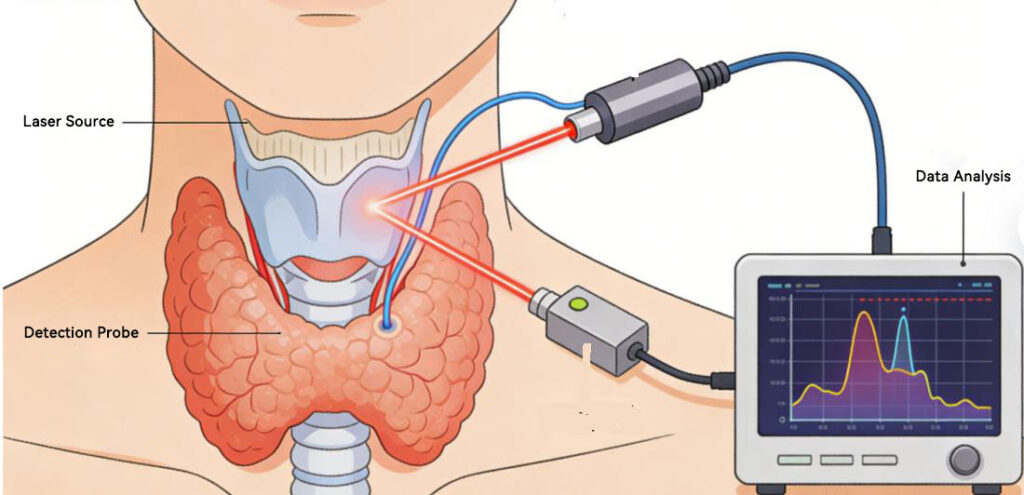
Diode lasers, as optoelectronic devices with small size, stable performance, and high precision, are playing an irreplaceable role in the screening and identification of thyroid lesions with unique technological advantages, providing a new technological path for the evaluation of tissue status. RealLight has been deeply involved in the field of medical spectral detection light sources for many years. We have independently developed a full range of fiber coupled and narrow linewidth diode laser modules, which are specially adapted and optimized for non-invasive optical detection of the thyroid gland. They cover core bands such as 532nm, 638nm, 785nm, and 1064nm that are suitable for thyroid tissue detection, and have become the preferred solution for core light sources in thyroid optical diagnostic equipment.
The core advantage of diode lasers lies in their precisely controllable spectral characteristics and highly directional beam output. This type of laser can output monochromatic light of specific wavelengths according to detection requirements, and there are significant differences in the absorption, scattering, and reflection patterns of specific wavelength light in thyroid tissues of different states – the molecular structure and cell density of normal tissues and abnormal proliferative tissues are different, resulting in clear differentiation of the optical response generated by the interaction between light signals and tissues. The RealLight narrow linewidth series laser adopts VBG lock-in+built-in TEC cooling scheme, with a linewidth below 0.1nm and wavelength stability of up to ± 7pm/℃, greatly reducing the spectral drift caused by environmental temperature fluctuations. It can stably output high monochromaticity laser and accurately match the optical absorption and scattering curves of normal, nodular, hyperplastic, and malignant thyroid tissues, effectively reducing detection signal noise. Based on this principle, diode lasers can serve as “optical probes” by emitting lasers of specific wavelengths to irradiate the thyroid region, and then using high-sensitivity detectors to capture changes in reflected or transmitted light signals, thereby constructing an optical characteristic map of the tissue and providing data support for subsequent state analysis.
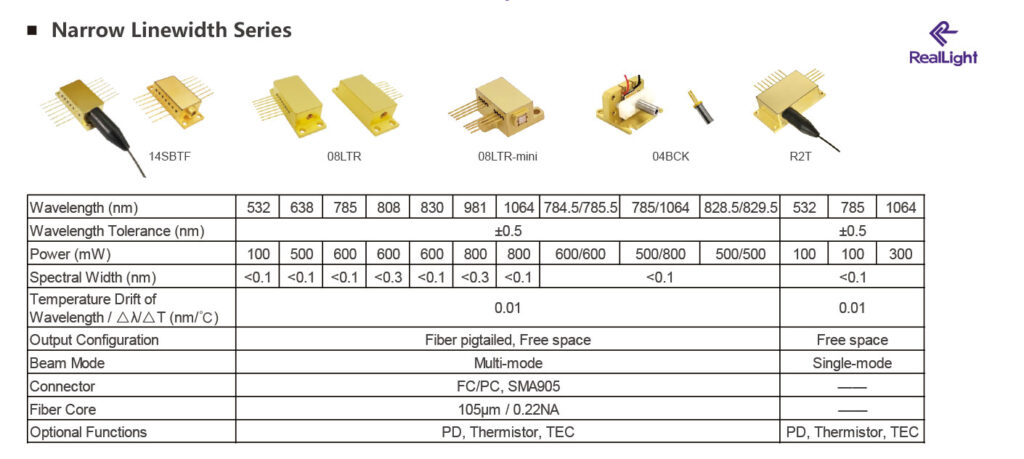
Diode laser
In practical testing scenarios, the application of diode lasers demonstrates significant convenience and safety. Compared to traditional detection methods, diode laser based detection systems do not require complex sample preparation processes and can achieve non-invasive in-situ detection – the laser beam is transmitted to the detection probe through optical fibers, and signal acquisition can be completed by simply placing it close to the neck skin. The entire process does not require contact with the interior of the tissue, avoiding unnecessary trauma and interference. At the same time, the output power of the diode laser can be precisely controlled within a safe threshold, and the laser energy only acts on the optical detection layer of the tissue surface, without causing adverse effects on the surrounding normal tissue. This not only ensures the safety of the detection process, but also enhances the sensory experience of the detection object.
Accurately identifying lesion characteristics is the core value of diode lasers in this field. Abnormal hyperplasia of thyroid tissue results in differences in cell arrangement, collagen content, and other aspects compared to normal tissue, which can lead to regular changes in optical parameters such as laser scattering coefficient and absorption coefficient. For example, an increase in cell density in some diseased tissues can lead to a significant increase in laser scattering intensity; And changes in the content of certain specific substances can cause a shift in the absorption peak of the laser. diode lasers, with their narrow linewidth and high monochromaticity, can accurately capture these subtle optical signal changes, and through matching data analysis algorithms, convert the optical signals into quantifiable tissue characteristic parameters, thereby achieving precise identification of thyroid tissue status. In addition, the miniaturization and low cost advantages of diode lasers also provide favorable conditions for their popularization in the field of thyroid detection. Traditional optical detection equipment often has a large volume, complex structure, and high manufacturing cost, making it difficult to widely apply in grassroots scenarios. The diode laser uses a diode chip as the light-emitting core, which is compact in size and lightweight. It can be integrated with components such as optical fibers and detectors into a portable detection device, making it convenient for operators to use flexibly in different scenarios. At the same time, the mass production technology of diode lasers is mature, with relatively low manufacturing costs, which can effectively reduce the overall cost of detection equipment and promote the coverage of related detection technologies in a wider range of scenarios. With the continuous development of optoelectronic technology and data analysis algorithms, the application of diode lasers in thyroid detection will continue to upgrade. In the future, by optimizing the selection of laser wavelengths, improving the detection sensitivity of optical signals, and perfecting data analysis models, it is expected to further improve the accuracy and specificity of detection, and achieve precise identification of early small lesions. At the same time, by combining technologies such as artificial intelligence and the Internet of Things, an intelligent detection system can be constructed to achieve real-time transmission, analysis, and sharing of detection data, providing more comprehensive technical support for dynamic monitoring and evaluation of organizational status. diode lasers, with their unique optical characteristics and technological advantages, are opening up a precise, safe, and convenient technological path in the field of thyroid tissue state detection. The application of diode lasers runs through various stages of the detection process, from the emission and detection of optical signals to the analysis and identification of tissue characteristics, providing reliable technical support for the assessment of thyroid tissue status. With the continuous iteration and improvement of technology, it is believed that diode lasers will play a greater role in related fields, providing stronger technological empowerment for monitoring and ensuring the health status of human tissues.
Disclaimer: Some content in this article is sourced from the internet for technical research and discussion purposes. It is intended for reference and learning only. Please kindly point out any inaccuracies. For copyright concerns, contact us for verification and removal.





 777
777