
Recommended selection of handheld LIBS lasers
I. LIBS Core Principles
LIBS stands for Laser Induced Breakdown Spectroscopy.
LIBS technology uses high-energy pulsed laser as the excitation source, which is focused by an optical system and acts on the surface of the sample. The sample area covered by the focused spot has a high energy density. When the energy exceeds the breakdown threshold, plasma is locally generated, which is called laser-induced plasma. This type of plasma has high local temperature and energy density. During the cooling process of the plasma, excited atoms and ions undergo electronic energy level transitions, emitting photons of specific wavelengths. Using a spectrometer to collect the released photons and obtain a spectrum, the elemental composition of the tested sample can be determined by analyzing the peak positions, peak intensities, and other information in the spectrum. The schematic diagram of the LIBS system is shown below. After the laser is focused by a lens, it hits the surface of the sample, exciting the plasma. The plasma spectrum enters the optical fiber through the collection lens, and then enters the spectrometer through the optical fiber. The spectrometer collects the spectral signal, which is then processed by the processor, compared with the database, and analyzed for the composition of the sample elements.
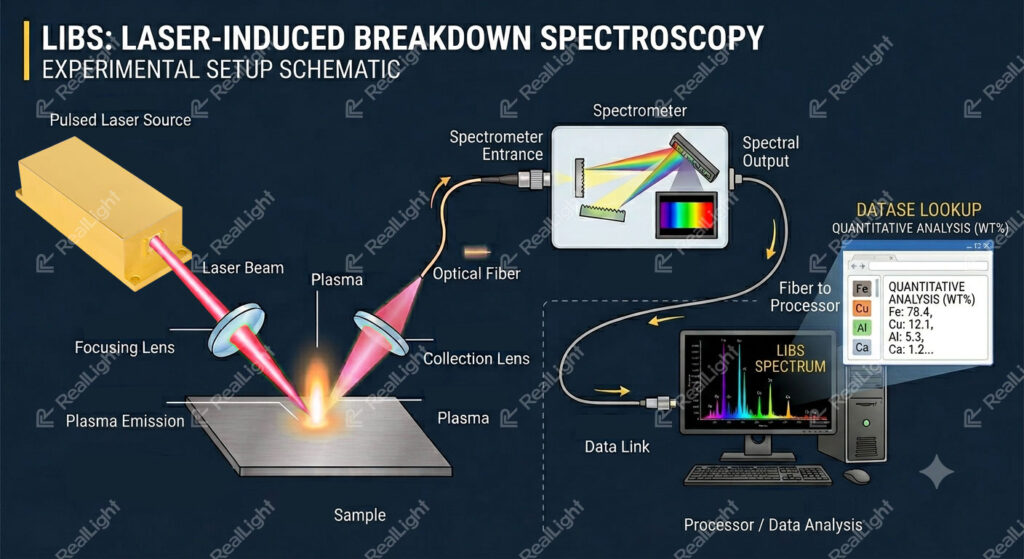
LIBS system schematic diagram
LIBS technology has existed for many years, mainly used in laboratory models. In recent years, with the development and miniaturization of lasers and spectrometers, handheld models have been introduced. By integrating lasers, miniature spectrometers, main controllers, and batteries into a gun style body, on-site non-destructive and rapid testing can be achieved without the need for pre-treatment such as sample polishing and digestion.
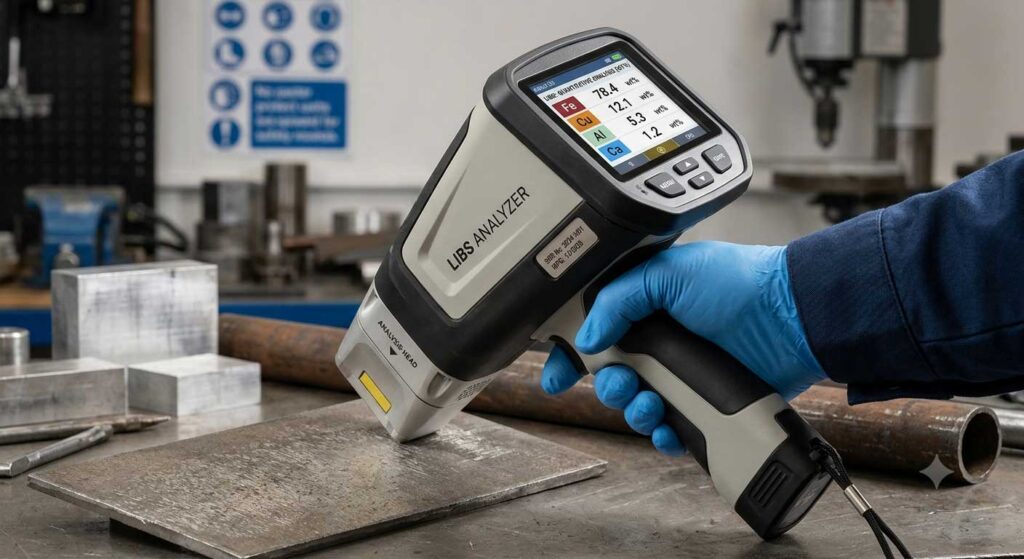
Handheld LIBS analyzer
II. Core advantages and disadvantages of handheld LIBS analyzer (compared to mainstream handheld XRF)
advantage
1. Light element detection is superior to XRF: it can accurately detect C, Li, B, Be, Mg, Al, Si, distinguish 304/304L, carbon steel carbon content, and lithium positive electrode materials. XRF is almost unable to detect carbon and lithium elements
2. No radioactive source: The laser safety level belongs to Class 3B, with no X-ray radiation, no need for radiation filing or environmental impact assessment approval, and no regulatory restrictions on cross plant/cross site use
3. Ultra fast detection: Results can be obtained in 1-3 seconds with small light spots, commonly ranging from 50 to 100 μ m. It can detect solder joints, coatings, small areas, and rough corroded surfaces
4. Minor damage: Surface erosion is only at the micrometer level, and cultural relics and precision parts can be screened without damage
5. Wide measurement range: covering all elements from lithium to heavy metals
disadvantage
1. The overall quantitative accuracy is weaker than XRF
2. The cost of lasers and miniature spectrometers is high, and the overall selling price is higher than that of handheld XRFs of the same grade
III. Mainstream application scenarios of handheld LIBS analyzer
1. Industrial PMI material verification (maximum downstream, accounting for approximately 45%)
Pressure vessels, pipeline welds, stainless steel/alloy steel, aluminum alloy, copper alloy incoming re inspection, steel mill furnace rapid sorting, special equipment flaw detection
2. Recycling and sorting of scrap metals
Rapid sorting of mixed scrap steel, aluminum magnesium waste, and copper nickel impurities to solve the pain points of sorting carbon containing alloy steel
3. Lithium ion new energy (fastest growing track)
Screening of incoming components for lithium iron phosphate, ternary materials, lithium salts, aluminum foil and copper foil, and identification of lithium battery recycling materials
4. Geological and mineral exploration
Rapid screening of ore grade in the wild and on-site monitoring of soil heavy metal pollution
5. Petrochemical power
Identification of corroded materials in pipelines, inspection of alloy fittings in power plants, and detection of silicon content in hydrogenation units
6. Cultural, archaeological, security emergency, and special incoming material quality inspection
IV. Development and Trends of Handheld LIBS Analyzer
At present, imported models are expensive, and in the high-end market, overseas brands dominate, occupying high gross profit orders in petrochemical, nuclear power, and aviation industries through precision, stability, and brand barriers; In the mid-range market, domestic products are rapidly breaking through, with obvious advantages in cost-effectiveness and localized after-sales service. Lithium batteries, renewable resources, and small and medium-sized manufacturing enterprises are gradually replacing imports; In the low-end market, the main focus is on the entry-level demand for scrap metal sorting, with domestic models occupying the majority of the market, and there are no corresponding models for foreign products.
At present, LIBS is in a slow development period, with favorable technology and policies, but there are also development bottlenecks and challenges.
Technological and policy benefits:
1. XRF cannot meet the urgent needs of carbon/lithium detection
New energy lithium batteries, carbon containing alloy steel, and 316L low-carbon stainless steel are subject to mandatory screening, and only LIBS can be quickly detected on site. They are irreplaceable for urgent needs
2. Policy dividends of renewable resources
Standardize the recycling of scrap steel, scrap aluminum, and non-ferrous metals, and promote the popularization of rapid sorting equipment due to environmental protection and tax supervision
3. Mandatory safety testing for special equipment
Regular PMI material verification for pressure vessels, pressure pipelines, and boilers, with huge market replacement potential
4. Non radiation compliance advantages
The XRF radiation reporting process is cumbersome, and factories, parks, and cross regional inspections prioritize the procurement of LIBS to avoid regulatory costs
5. Domestic substitution policy
Special support for high-end scientific instruments, breakthroughs in the localization of laser and micro spectral core components, and continuous cost reduction of the entire machine
Development checkpoints and challenges:
1. Core component bottleneck
High end narrow linewidth pulse lasers, high-precision diffraction gratings, and refrigeration detectors still heavily rely on imports, which increases costs and limits performance limits
2. Shortcomings in quantitative accuracy
The difficulty of matrix effect and surface interference correction algorithms is high, and it is still difficult to compete with desktop direct reading spectroscopy and laboratory ICP
3. Insufficient market awareness
Most terminals still prioritize the use of mature handheld XRF, and the cost of LIBS promotion and education is relatively high
4. Incomplete industry standards
The LIBS on-site testing national standard and metrological traceability system are not as complete as XRF, and some third-party testing institutions have limited reliability
5. High price
The price of the same configuration is higher than XRF, and the initial purchasing threshold for small and medium-sized customers is high
V. Overcoming laser technology adapted to handheld LIBS
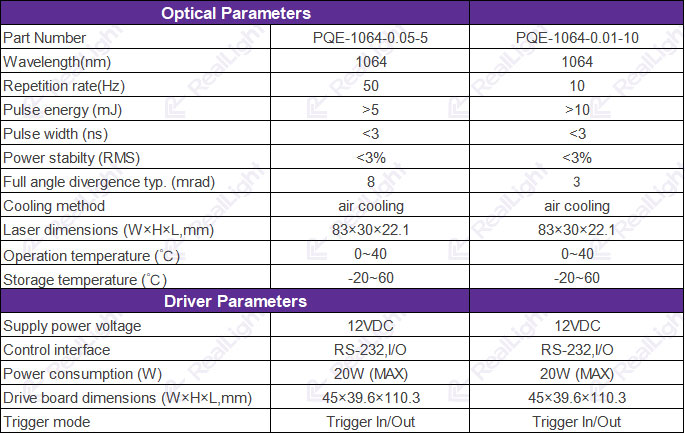
RealLight has always been concerned about the development of the LIBS industry. Referring to the laser parameters of high-end handheld LIBS models abroad, such as Thermo Fisher Scientific and Thermo Fisher Scientific, combined with the company’s own technological advantages, it has launched a miniaturized high-energy nanosecond laser with a repetition rate of up to 50Hz and a single pulse energy greater than 5mJ. The laser adopts end pump technology, and the laser volume of the end pump scheme is about one-third of that of the side pump scheme, which can meet the miniaturization needs of handheld models. The pump source adopts the stacked array light source produced by RealLight, which can be highly customized according to needs and has an absolute cost advantage, without the need for external pump sources. Stacked array light source is a surface light source formed by stacking multiple semiconductor bars together, greatly increasing peak power and having a compact size.
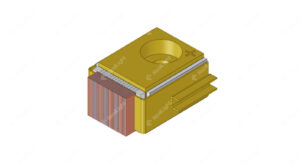
RealLight Stacked Array Light Source for End-Pumping
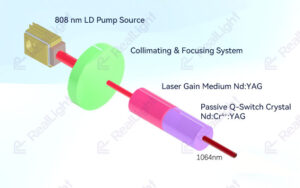
End-pumping configuration: Small cross-section, suitable for handheld LIBS instruments
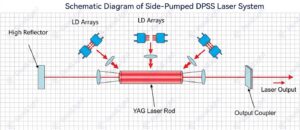
Side pump method: Large cross-section, not suitable for handheld LIBS devices
The laser adopts a passive Q-switching scheme, with Nd: YAG and Cr: YAG crystal bonding. The technical route is consistent with the characteristic micro chip laser of RealLight. We have deep technical accumulation in related processes, which can achieve characteristics such as long life, high stability, and wide temperature operation. The environmental adaptability of bonded crystals is excellent, suitable for applications where handheld devices are frequently transported and vibrated, and can even withstand the risk of falling and damage.
The laser is equipped with a semiconductor cooler, which allows the laser to operate at a constant temperature without fear of outdoor high and low temperature environments.
The laser also adopts parallel sealing technology, which is sealed in an inert gas environment, which is conducive to extending the life of the laser and does not require screws, further reducing the volume.
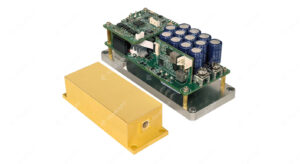
RealLight Lasers Optimized for Handheld LIBS Devices
Parameters of RealLight Lasers Optimized for Handheld LIBS Devices:
Disclaimer: Some content in this article is sourced from the internet. It is intended for technical research and exchange purposes, and is solely for your reference and learning. If there are any inaccuracies or academic errors in the description, please feel free to point them out promptly. If there are any copyright issues involved, please contact us and we will verify and remove them as soon as possible.





 777
777