
Stacked semiconductor laser
Semiconductor lasers are widely used in people’s daily life and work, such as laser printers, fiber optic network signal transmission, vehicle mounted LiDAR, laser processing equipment, and laser detection equipment. One of the most important applications is as a pump source to produce other types of lasers, such as fiber lasers, solid-state lasers, etc. Compared to other types of pump sources such as xenon lamps, semiconductor lasers have advantages such as good monochromaticity, high peak power, compact size, and long lifespan.
The chip manufacturing method of semiconductor lasers can be seen from its name, which is similar to traditional semiconductor chips, both of which are produced by photolithography machines to form chips, with the difference being the size of the feature dimensions. The chip size of semiconductor lasers is in the micrometer range, while the chip size in our mobile phones or computers has reached the nanometer range.
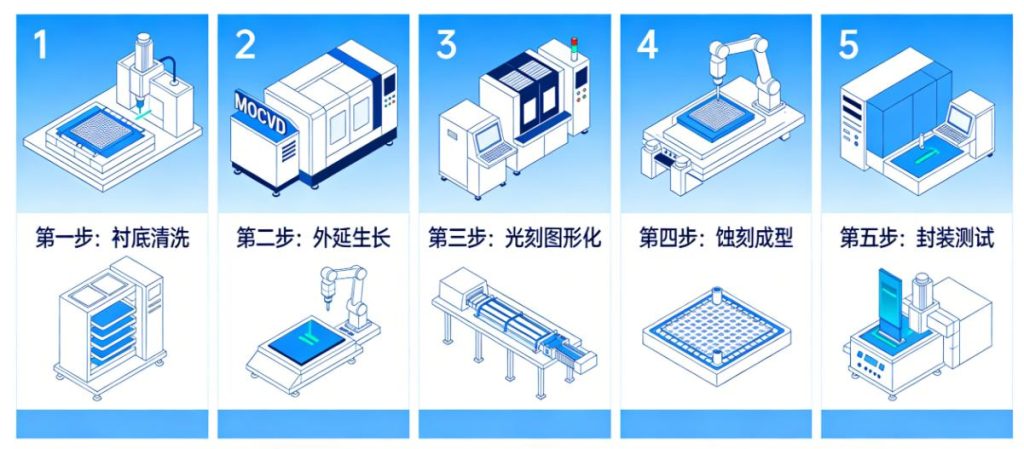
After wafer processing, it is first cut into bars, which then dissociate to form chips. The vast majority of fiber coupled semiconductor lasers we see are packaged and coupled using chips: they are connected in series, compressed along the fast and slow axes, shaped and focused into the fiber, and transmitted through the fiber. When used as a pump source, in order to obtain high-power laser output, multiple chips are packaged in one tube to increase the power of the pump source. In some low repetition rate and high-energy lasers, in order to achieve small size and long lifetime, a stacked array semiconductor composed of bars is needed as the pump source.
From the processing of semiconductor laser chips, we can understand that the power of the bars is much greater than that of a single chip, and a stacked semiconductor laser composed of bars of the same or different wavelengths arranged closely together will achieve greater power.
The types of bars are divided into continuous and pulse types. Continuous bars generally use water cooling, and the lighting time is on the order of ms or s; Pulse type bars work in a pulsed state, with a lighting time on the order of tens to hundreds of μ s. It can also be divided into full bar, 1/2 bar, and 1/3 bar according to the length of the bar. By using different types of bars and different arrangement methods, stacked semiconductor lasers can be produced for different application scenarios.
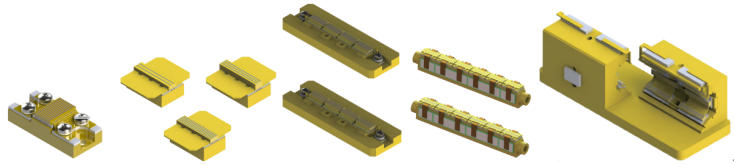
Stacked semiconductor laser
As a professional laser manufacturer, RealLight can produce different types of stacked semiconductor lasers, fiber coupled semiconductor lasers, semiconductor pumped solid-state lasers and other laser products. Among its stacked semiconductor laser products, products such as GS06 and GS07 at 1/2 bar can be equipped with external cylindrical mirrors to compress the fast axis divergence angle, and are used in end pumped lasers with conduction cooling; GS12/GS15/GS16/AA series/PA series and other stacked arrays, with high peak power, are mainly used for side pumped lasers with conduction cooling; The WA series stacked array products can be combined in multiple groups to produce water-cooled high peak power side pump modules. In all stacked arrays, the same wavelength or different wavelengths can be used for combination. When different wavelength bars are used for combination, solid-state lasers can achieve stable laser energy output over a wide temperature range.
Stacked semiconductor lasers are essential core components for producing high-energy solid-state lasers. As a professional laser manufacturer, RealLight will be your indispensable partner.
Disclaimer: Some content in this article is sourced from the internet for technical research and discussion purposes. It is intended for reference and learning only. Please kindly point out any inaccuracies. For copyright concerns, contact us for verification and removal.





 777
777