
Diode-Pumped Solid-State Lasers for Laser-Induced Breakdown Spectroscopy (LIBS)
In recent years, laser-induced breakdown spectroscopy (LIBS) technology has demonstrated great potential and broad application prospects in various fields such as industrial inspection, environmental monitoring, and material scientific research, thanks to its rapid and non-destructive elemental analysis characteristics. The core lies in using high-energy laser pulses to instantaneously excite the sample to generate plasma, and achieving precise detection of material composition by analyzing the plasma emission spectrum. The performance of the “heart” of the LIBS system – the laser – directly determines the accuracy of the analysis and the efficiency of the work.
Introduction to LIBS Technology
LIBS technology is based on the fundamental principle of the interaction between lasers and matter:
Plasma formation: By focusing high-energy laser pulses, all substances on the surface of the sample are instantaneously vaporized, forming high-temperature plasma.
Spectral emission: Atoms and ions in a plasma emit characteristic spectra during the deexcitation process.
Component analysis: By collecting and analyzing the characteristic spectra, the spectrometer can perform qualitative and quantitative analyses of the properties of elements (i.e., the characteristic spectral lines they possess).
Another advantage of LIBS technology is that it does not require complex sample pretreatment and can achieve rapid multi-element analysis of various forms of samples such as solids, liquids, and gases. It is particularly suitable for online detection and remote analysis in industrial sites.
The wide application of LIBS
Industrial material analysis: such as aluminum alloy composition detection, metal scrap sorting, film material composition analysis, etc.
Environmental monitoring: Heavy metal detection in soil, pollutant analysis in water bodies.
Research fields: Analysis of ancient building materials, analysis of antique art, deep-sea exploration, etc.
Biomedicine: Serum disease marker recognition and screening, tissue element distribution imaging, etc.
Relying on the application of LIBS, we can quickly sort out the alloys of waste aluminum in the aluminum recycling industry, thereby greatly improving the efficiency of resource reuse. At the same time, first-hand data can be obtained for the analysis of the proportion of elements in transparent conductive films such as Al-In-Sn-O, thereby optimizing their better photoelectric performance, etc.
The characteristics of lasers used for LIBS
To achieve stable plasma excitation and high-quality spectral signals, the laser used in LIBS systems needs to have:
High single-pulse energy (usually at the millijoule level) : The high single-pulse energy ensures that the sample can be effectively broken down, thereby generating plasma of sufficient intensity.
Short pulse width (nanosecond level) : It not only significantly increases the peak power but also effectively reduces the thermal effect on the components under test. It can provide good protection for some components that are sensitive to high temperatures.
Excellent beam quality: The feature of small and uniform light spots greatly enhances its spatial resolution.
With the continuous increase in the energy of traditional flasher-pumped lasers, a series of drawbacks such as their large size and low repetition rate have emerged. Currently, diode-pumped solid-state lasers (DPSSL) have initially become one of the ideal choices for LIBS systems due to their compact structure, high efficiency, and stable operation.
RealLight’ diode-pumped solid-state lasers tailored for LIBS
The PQE series of diode-pumped solid-state lasers launched by RealLight are specifically optimized for LIBS applications and feature the following characteristics:
Wavelength: 1064 nm
Single pulse energy: 10 mJ
Repetition frequency: 10 Hz
Pulse width: <3 ns
Compact design: It can be conveniently integrated with various portable or online LIBS systems in an extremely small volume
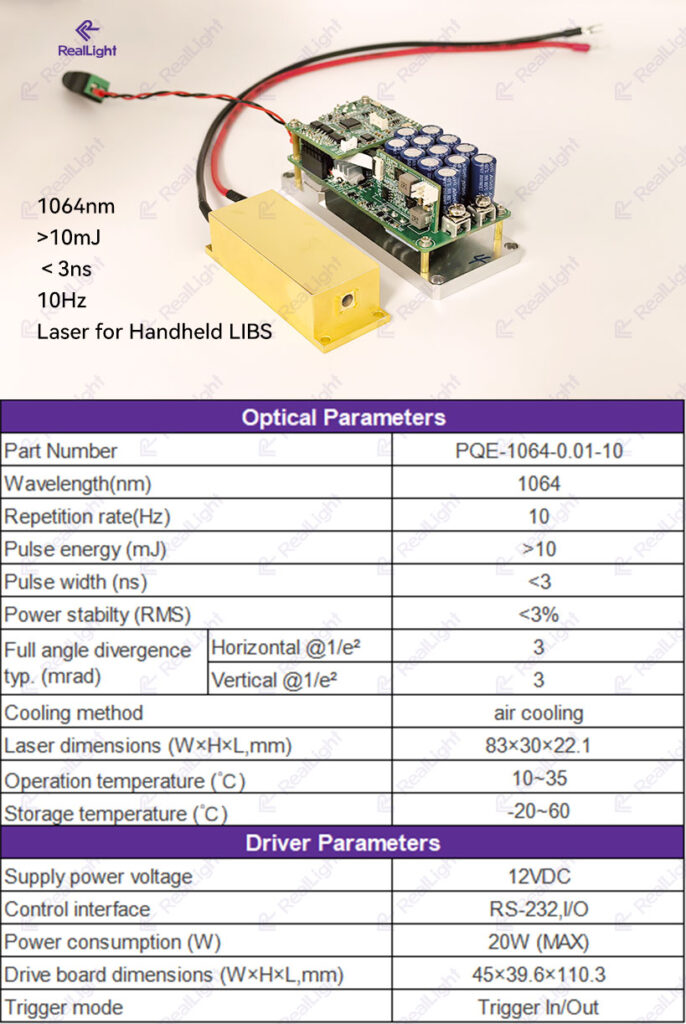
The laser pulses output by RealLight‘s PQE series of diode-pumped solid-state lasers feature both high energy and short pulse width. They not only effectively excite plasma but also significantly suppress background noise. When combined with non-gated detectors, they can achieve high signal-to-noise ratio spectral acquisition.
With the continuous development of LIBS technology, to move towards portability, intelligence and commercialization, compact and high-performance lasers are indispensable. The diode-pumped solid-state laser independently developed by RealLight for LIBS features excellent parameter performance and reliable design, serving as the core driving force for providing users with precise analysis.
Disclaimer: Some content in this article is sourced from the internet. It is intended for technical research and exchange purposes, and is solely for your reference and learning. If there are any inaccuracies or academic errors in the description, please feel free to point them out promptly. If there are any copyright issues involved, please contact us and we will verify and remove them as soon as possible.





 777
777