
Diode Laser Array
A diode laser array typically refers to the vertical or multidimensional “stacking” of multiple laser chip cores (particularly diode lasers) through precision optical and structural design, forming a compact, high-performance module.
Laser diode arrays are commonly used as pump sources for high-power solid-state lasers, offering high power, high efficiency, high reliability, and compact size, making them irreplaceable. Beyond laser pumping, laser array products are also applied in beauty treatments, lighting, and processing applications.
Despite its extremely compact size, it achieves exponential improvements in power, brightness, and beam quality while maintaining high efficiency and reliability.
A single laser diode bar can deliver continuous output power ranging from tens to hundreds of watts, significantly enhancing laser density and output stability. By precisely stacking multiple bars vertically (even stacking several to dozens), a diode laser array module can easily achieve pump light outputs ranging from hundreds of watts to thousands of watts.
Pump Structure:
End-Face Pumping: Light from stacked arrays is shaped and pumped directly or via optical fibers into the crystal end-face. This configuration features simple structure, high efficiency, and excellent beam quality.
Side-Face Pumping: Multiple stacked arrays are arranged around the laser crystal rod for pumping. This method enables higher power output.
Beam Shaping:
Fast-Axis Collimation Lens: Equips each beam bar with a micro-cylindrical lens to compress the fast-axis divergence angle.
Slow-Axis Beam Shaping: Utilizes optical systems such as step mirrors and mirror arrays to integrate and homogenize light from multiple beam bars along the slow-axis direction.
RealLight’s GS06 series diode laser array is a compact, multi-wavelength product that can also output a single wavelength. Each bar is 5mm long with a power output of 150-200W, and the package can accommodate up to 9 bars. This structure features fast-axis collimation (FAC) and slow-axis collimation (SAC). Other wavelengths and packaging forms can be customized.
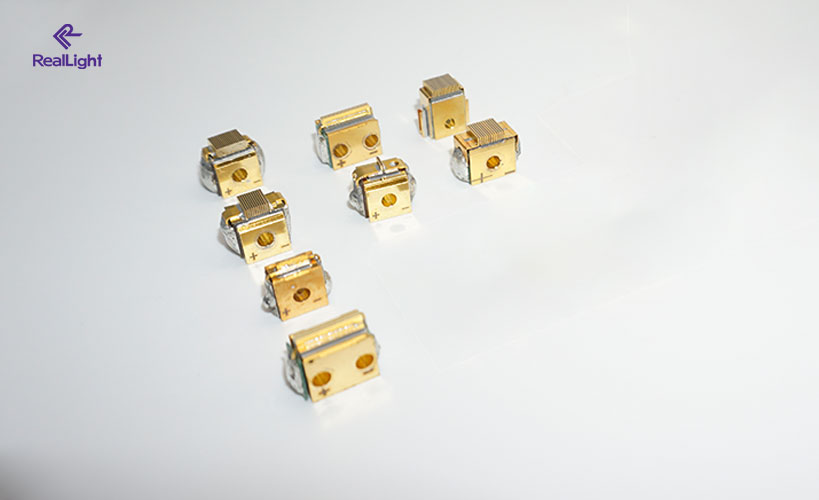
Diode Laser Array
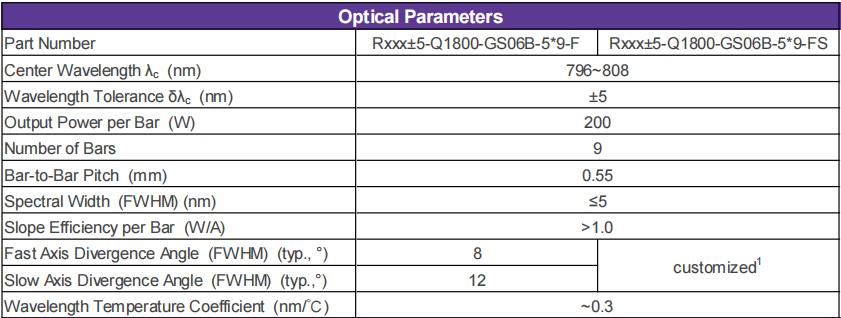
Diode Laser Array
Disclaimer: Some content in this article is sourced from the internet for technical research and discussion purposes. It is intended for reference and learning only. Please kindly point out any inaccuracies. For copyright concerns, contact us for verification and removal.





 777
777