
Industrial applications of Raman probes
As a domestic company specializing in the research and application of Raman spectroscopy technology, RealLight‘s Raman probe products have important application scenarios in multiple industries. Raman probe is one of the core components of Raman spectroscopy system, which is used to achieve the transmission and focusing of excitation light, as well as efficient collection and transmission of Raman scattering light. RealLight’s Raman probe has been widely used in the following industries due to its performance, stability, and customization capabilities:
Pharmaceuticals and Biopharmaceuticals:
API identification and purity control: Quickly and non destructively confirm the chemical structure, crystal form (polycrystalline analysis is crucial), and purity of the API to prevent counterfeit and inferior raw materials from entering the production line.
Production Process Monitoring (PAT): Integrating probes into reaction vessels, pipelines, or fluidized beds to monitor in real-time the progress of chemical reactions (such as reactant consumption, product generation, and the appearance of by-products), crystallization processes, mixing uniformity, etc., to achieve process analysis technology, optimize processes, and ensure batch consistency.
Quality testing of finished drugs: Quickly identify the authenticity of drugs (anti-counterfeiting), confirm the active ingredients, auxiliary ingredients and content, test the uniformity of the mixture, and screen for illegal additives without damage.
Chemical and Petrochemical:
Reaction process monitoring: online monitoring of key chemical processes such as polymerization reactions and catalytic reactions, real-time understanding of reactant conversion rates, product selectivity, catalyst status, etc.
Raw material and intermediate identification: Quickly confirm the chemical composition of incoming raw materials and intermediate products.
Product composition and quality control: Analyze polymer structure, copolymer composition, additive distribution, oil composition (such as gasoline octane number, diesel cetane number related components), etc.
Corrosion and sediment analysis: Identify corrosion products, scale deposits, catalyst carbon deposits, etc. on the inner walls of pipelines or equipment.
Environmental monitoring: detecting specific pollutants in wastewater and exhaust gas (often combined with surface enhanced Raman spectroscopy).
Materials Science and New Energy:
Characterization of semiconductor materials: Analyze the stress, lattice quality, and doping concentration of silicon wafers; Study the number of layers, defects, doping, strain, etc. of low dimensional materials such as carbon nanotubes and graphene.
Lithium battery research: In situ/non in situ analysis of the structural evolution and phase transition process of electrode materials (such as lithium iron phosphate, ternary materials, silicon negative electrodes); Study the decomposition products of electrolyte and the composition of SEI film; Evaluate the mechanism of battery aging.
Photovoltaic materials: Analyze the crystal structure, phase purity, and component distribution of solar cell materials such as perovskite, silicon, and CIGS.
Polymer and Composite Materials: Research on polymer chain structure, crystallinity, orientation, blending compatibility, filler dispersibility, interface interactions of composite materials, etc.
Nanomaterials: Characterize the size, morphology, composition, and surface chemistry of nanoparticles (often combined with SERS).
Food Safety and Agriculture:
Rapid screening of pesticide residues: (often combined with SERS technology) on-site rapid detection of trace pesticide residues on the surface of fruits and vegetables.
Food adulteration and authenticity identification: Identify the type of edible oil (such as gutter oil), whether milk is adulterated or adulterated, the authenticity of honey, the authenticity of alcohol, seasoning ingredients, etc.
Food ingredient analysis and quality control: detecting additives (such as preservatives, pigments), nutritional components, moisture content, degree of fat oxidation, etc. in food.
Quality analysis of agricultural products: evaluate fruit maturity, grain protein/starch content, etc.
Geology, Mineral Resources, and Jewelry:
Mineral identification and analysis: Quickly and non destructively identify mineral types in the field or laboratory (especially effective in distinguishing similar minerals), and analyze the composition of inclusions.
Oil and gas exploration: analysis of mineral composition, organic matter maturity, fluid inclusions, etc. in rock cores and drill cuttings.
Jewelry and Jade Identification: Non destructive identification of gemstone types (such as diamonds, sapphires, and jadeite), differentiation between natural and synthetic gemstones, and testing of gemstone processing (such as filling and staining).
Public Safety and Criminal Investigation:
Rapid detection of drugs and precursor chemicals: Handheld or portable Raman systems equipped with specialized probes are used for on-site rapid screening of suspected drugs and precursor chemicals.
Explosive detection: Quickly identify common explosive components.
Criminal investigation evidence analysis: Non destructive analysis of trace evidence such as fibers, paint fragments, ink, and cosmetic residues.
Environmental monitoring:
Water pollution detection: (often combined with SERS or pretreatment) detecting heavy metal ions, organic pollutants (such as polycyclic aromatic hydrocarbons, pesticides), microplastics, etc. in water bodies.
Analysis of Air Pollutants: Study of Aerosol Composition.
The advantages of RealLight‘s Raman probe are reflected in these application scenarios:
High performance: high sensitivity, high signal-to-noise ratio, high resolution (depending on configuration), meeting the demanding needs of scientific research and industry.
Stability and reliability: Industrial grade design, suitable for long-term online monitoring and use in harsh environments.
Flexibility and Customization: We offer multiple types of probes (such as confocal microscopy probes, non-contact probes, immersion probes, fiber optic probes, high temperature and high pressure probes, SERS probes, etc.), and can be deeply customized for specific application scenarios (such as pharmaceutical PAT, chemical online, portable testing) (material compatibility, size, interface, protection level IP, explosion-proof certification ATEX/IECEx, etc.).
Fiber optic coupling capability: convenient for remote detection and system integration.
Professional support: Provide application development and technical support to help customers solve practical problems.
In summary, RealLight‘s Raman probe plays a key role in many fields that require fast, non-destructive, in-situ/online acquisition of material molecular structure information, especially in pharmaceutical process monitoring, chemical process optimization, new energy material research and development, and food, thanks to its technological strength and product characteristics.
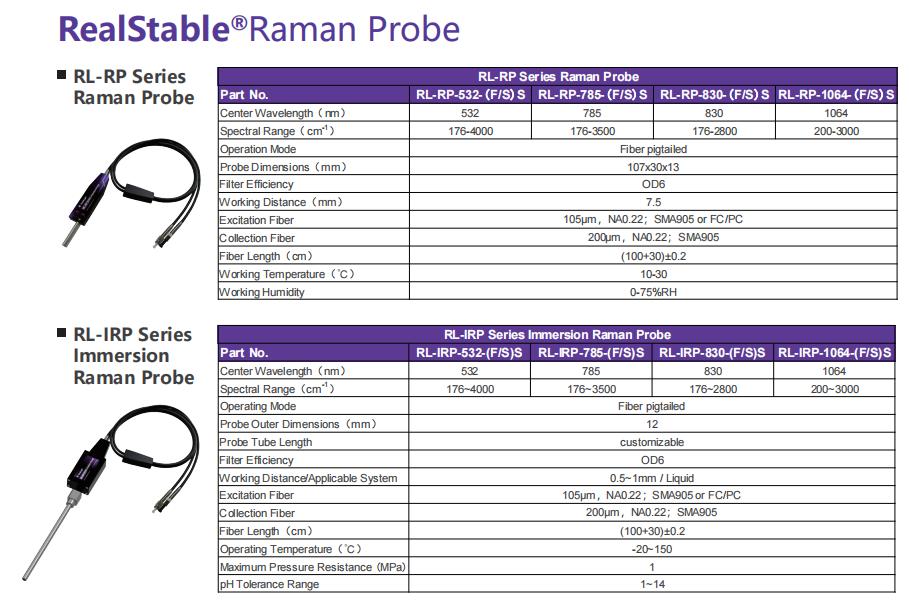
Technical Specifications of Raman Probe and Immersion Raman Probe
Disclaimer: Some content in this article is sourced from the internet for technical research and discussion purposes. It is intended for reference and learning only. Please kindly point out any inaccuracies. For copyright concerns, contact us for verification and removal.





 777
777