
Microchip Laser: A New Engine Leading LIBS Technology towards Localization and Intelligence
1、 The principle of LIBS technology and the bottleneck of traditional light sources
By relying on the action of high-energy laser pulses, rich plasma can be generated on the surface of the sample, allowing for rapid, comprehensive, and non-destructive acquisition of “fingerprint” information such as the elemental composition and relative abundance of the sample through high-sensitivity analysis of the emission spectrum of the plasma. The analytical capability and application boundaries of its LIBS system depend on the performance of the laser used. However, due to the use of solid-state lasers pumped by lamps or diodes in traditional LIBS systems, although they perform reliably in terms of stability, their large size and high energy consumption limit their widespread application in the field of rapid on-site detection.
2、 Core structure and product benchmark of microchip laser
The unique advantages of micro chip lasers have also revolutionized LIBS technology from traditional “one machine, one standard” to “one machine, multiple standards”. Its core advantages are reflected in the birth of micro chip lasers, which fully demonstrate the technological advantages, economic feasibility, and wide applicability of micro chip lasers. At the same time, it also fully utilizes the characteristics of micro chip lasers, fully reflecting the technical advantages, economic feasibility, and wide applicability of micro chip lasers. The series of micro chip lasers independently developed by RealLight are benchmark products adapted to LIBS technology. They adopt a semiconductor pumped passive Q-switching integrated architecture and optimize the fully sealed packaging process, combining core advantages such as narrow pulse width, high repetition rate, high pulse energy, and low power consumption. They can accurately match the stringent requirements of LIBS spectral analysis.
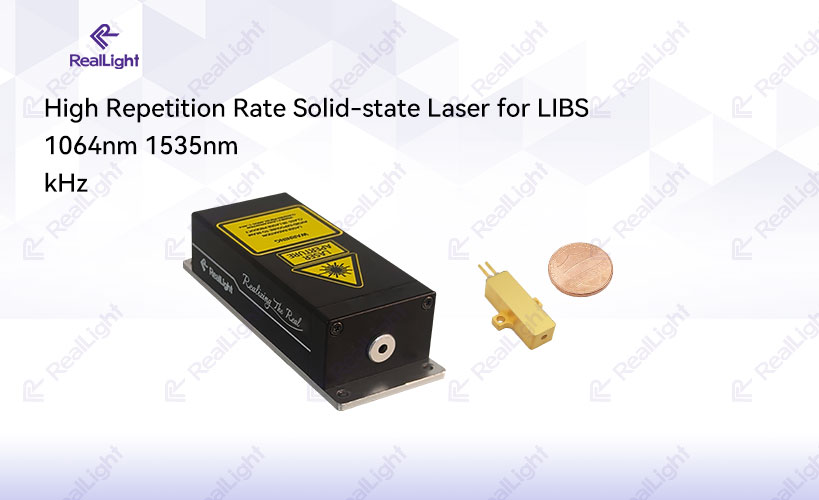
High Repetition Rate Solid-state Laser for LIBS 1064nm 1535nm kHz RealLight
3、 Small scale integrated design unlocks on-site portable application scenarios
By highly integrating the working material of the laser, Q-switching components (such as saturable absorbers), and a series of optical mirrors into a very thin chip, the microchip laser achieves the function of an all solid state laser. Its exquisite design brings several outstanding advantages to its application in LIBS: it can fully utilize the advantages of traditional LIBS such as “high efficiency” and “low energy consumption”, and greatly improve the “high”, “reliable”, “maintainable” and other “high” properties of LIBS, greatly enhancing the application value of LIBS and having important significance for improving the application level of LIBS.
With its extremely compact and durable structure, the micro chip laser has a small volume, even smaller than a matchbox. It only needs to be the size of a fingertip and does not require complex optical path adjustment mechanisms, greatly simplifying the technical difficulties it faces in practical work. With the help of integrated microchip lasers, LIBS instruments have transformed from indoor large machines to handheld portable instruments, greatly expanding their application scenarios in the field, production lines, mining areas, or public safety sites.
Based on its extremely short resonant cavity, it naturally possesses the output characteristics of a single longitudinal mode, which enables the generation of highly stable laser pulses close to the attenuation limit. From this, it can be seen that the analysis of LIBS is particularly important, as each laser pulse can be highly consistent with the energy and spot size of the sample, resulting in high repeatability and accuracy of the analysis results, and good reliability for quantitative analysis.
4、 High repetition rate and high-speed scanning, suitable for high-precision non-destructive testing requirements
By operating at a high repetition rate of kilohertz with the inherent advantage of nanosecond pulse width, the LIBS system is able to achieve high-speed scanning of samples and rapid imaging of their components. By utilizing high repetition rates, a large amount of spectral data can be collected in a very short period of time, resulting in a significant improvement in the signal-to-noise ratio of the obtained spectra through statistical averaging. This greatly enhances the accuracy of spectral analysis and can effectively avoid damage to samples due to the thermal effects of lasers, especially for fragile thermosensitive materials. It plays a significant role in the analysis of these materials.
5、 Low power consumption, high durability, suitable for long-term operation in harsh working conditions
By optimizing the electro-optical conversion efficiency of micro chip lasers, their power consumption is greatly reduced compared to traditional solid-state lasers, making them more suitable for long-term operation as portable devices powered by batteries. And its all solid state integrated design completely eliminates the existence of traditional mechanical moving parts, making it highly earthquake resistant with a lifespan of over 20 years. At the same time, due to its extremely low environmental requirements, it basically does not require maintenance to ensure that the equipment can work reliably in harsh environments.
6、 Global scenario implementation, empowering intelligent detection and upgrading across multiple industries
Based on its unique advantages, LIBS systems using microchip lasers are gradually becoming the preferred solution for in-situ, real-time, and online component analysis. The LIBS technology using micro chip lasers not only plays a crucial role in the rapid sorting of alloy components in the metallurgical industry, but also enables environmental monitoring and rapid analysis of heavy metal pollution in soil on site. It also has great potential for non-destructive identification of cultural relics’ materials in the field of archaeology.
In summary, the excellent characteristics of small size, high stability, high repetition rate, and low power consumption of micro chip lasers have successfully paved the way for the bottlenecks encountered in the traditional LIBS system towards on-site and intelligent development. It not only marks a major breakthrough in LIBS light source technology, but also provides a key engine for it to move from the “one leaf boat” originally grown in the laboratory to a wide range of applications. With the continuous reduction of cost and optimization of performance of microchip lasers, the main equipment form of high-performance and portable LIBS in the future will inevitably be replaced by them.
Disclaimer: Some content in this article is sourced from the internet. It is intended for technical research and exchange purposes, and is solely for your reference and learning. If there are any inaccuracies or academic errors in the description, please feel free to point them out promptly. If there are any copyright issues involved, please contact us and we will verify and remove them as soon as possible.





 777
777