
The Application of Multi-wavelength Diode Laser Light Sources in the Analysis of Optical Properties of Biological Tissues
In the analysis of the optical properties of biological tissues, to achieve highly sensitive and stable detection, the use of precise light sources is of great significance. Laser technology, with its high precision, high stability and customizability, has become an indispensable tool in biological analysis research. Among them, multi-wavelength diode laser light sources, due to their diverse and stable wavelengths, have become indispensable key light sources in numerous application fields such as spectral analysis, cell imaging, and biosensing. With the in-depth development of technologies such as fluorescence detection, flow cytometry, and confocal microscopy, the wide application of multi-wavelength and multi-channel laser light sources has provided a feasible approach for the excitation of complex biological samples, further significantly enhancing the sensitivity and accuracy of detection.
Each component of biological tissues has its unique absorption and scattering characteristics for light of different wavelengths. Therefore, the spectral response of the tissue can be obtained based on its absorption and scattering characteristics for light of different wavelengths, thereby analyzing its composition and structure. For example:
In spectral detection, the excitation of a laser of a specific wavelength is adopted to cause the intrinsic energy state of the biological sample to transition, thereby interacting with external energy and obtaining its fluorescence spectrum or absorption spectrum..” By analyzing these spectra, the target components can be precisely identified and quantitative analysis can also be conducted. Take blood testing as an example. If 405nm and 638nm lasers are used in combination, the characteristic spectra of hemoglobin and platelets can be obtained simultaneously without complex labeling or processing, and analysis and diagnosis can be completed quickly.
In the field of cell imaging, by leveraging the high-precision excitation effect of lasers of different wavelengths, support is provided for confocal microscopy or multi-photon microscopy techniques, enabling three-dimensional imaging of living cells or tissues. For instance, blue and green fluorescent proteins can be excited respectively by 450 nm and 520 nm lasers, enabling multicolor imaging of living cells.
In the field of biosensing, lasers can interact with biosensors to precisely detect the “binding events” of biomolecules closely related to diseases, enabling rapid and accurate screening of diseases. For instance, 638nm and 650nm lasers can be used for shallow tissue imaging, while the near-infrared band is suitable for deep tissue detection.
As a laser manufacturing enterprise that continuously innovates, RealLight has specially developed and designed the AWSO-B series multi-wavelength and multi-channel diode laser module for the excitation light source in biological analysis research. This module integrates single-mode fiber-coupled laser modules with multiple wavelengths and a multi-channel drive circuit, featuring the following:
1. Multi-channel output: Supports a total of 36 output channels of 4×9, enabling multi-wavelength combinations to meet the requirements of complex spectral analysis.
2. High stability: Built-in TEC cooling and real-time temperature monitoring ensure that the wavelengthing-temperature characteristic (△λ/△T) is only 0.3nm /℃.
3. Flexible control: Supports RS232 communication and DB9 interface. Each group can be independently controlled to achieve synchronous output.
4. Customized services: Available design and customization services for optical fibers, lenses, hand tools, etc., and support laser anti-reflection function and multi-mode laser output customization.
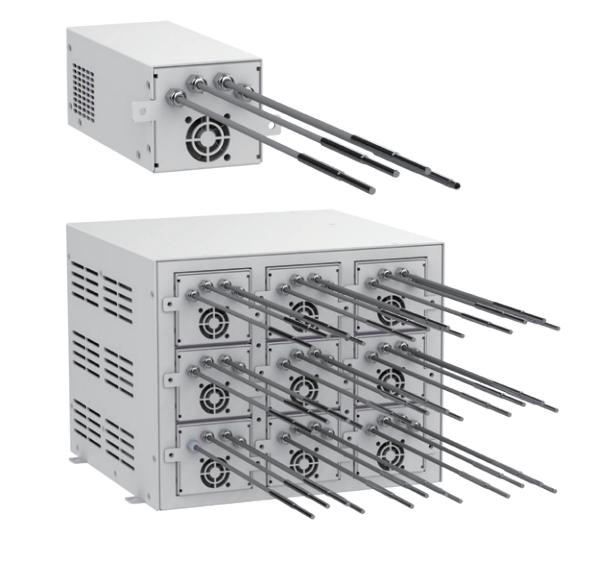
Multi-wavelength diode lasers
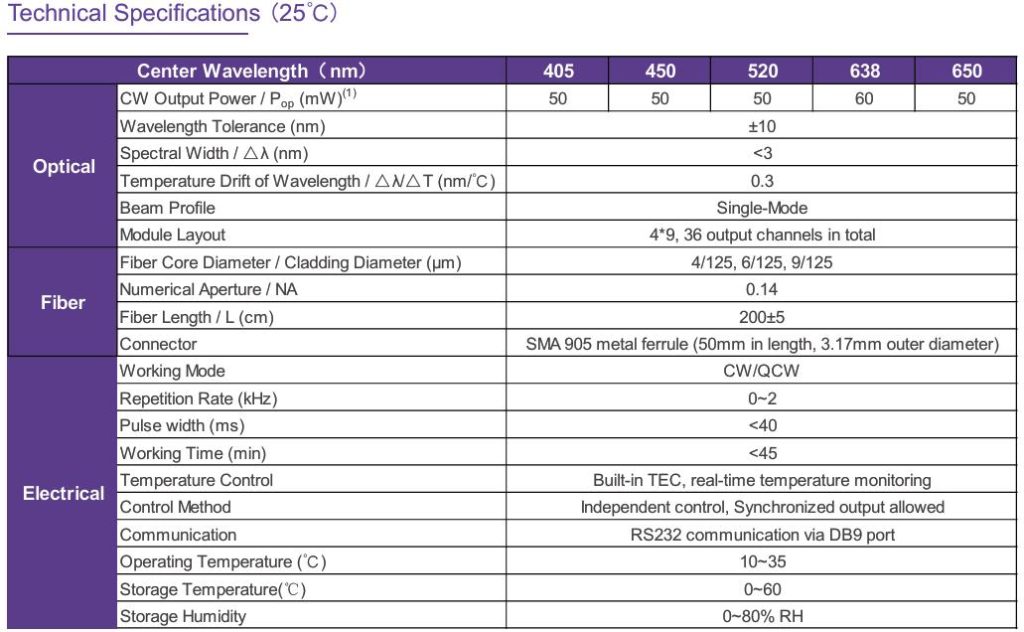
Multi-wavelength diode lasers
The AWSO-B series modules, with their compact design and plug-and-play convenience, can be easily embedded in the optical property analysis systems of various biological tissues, providing highly reliable laser light source support for both scientific research and industrial applications.
Disclaimer: Some content in this article is sourced from the internet for technical research and discussion purposes. It is intended for reference and learning only. Please kindly point out any inaccuracies. For copyright concerns, contact us for verification and removal.





 777
777