Free Space Faraday Rotator and Isolator
RealLight Free-Space Faraday Rotators & Optical Isolators Product Introduction
1. Product Overview
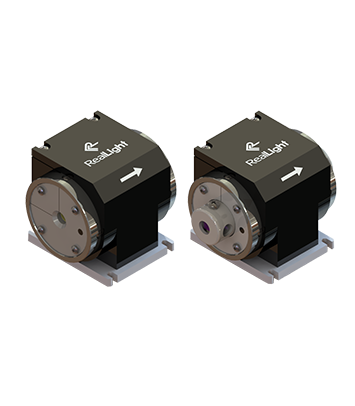
RealLight independently develops free-space Faraday rotators and Faraday optical isolators, core magneto-optical components based on the non-reciprocal Faraday magneto-optic effect. The products adopt high-quality TGG terbium gallium garnet magneto-optic crystals, high-precision polarization beam splitter (PBS) cubes and high-coercivity permanent magnet assemblies. Two product lines are available: Faraday rotators and Faraday isolators, covering mainstream near-infrared wavelengths 1030 nm and 1064 nm with two standard clear apertures (2.5 mm / 5 mm) under unified Size 3 packaging.
The Faraday rotator precisely rotates linearly polarized light by 45°, with rotation angle only determined by internal magnetic field and independent of beam propagation direction. Assembled with front and rear polarizing beam splitters, it forms a unidirectional optical isolator that efficiently blocks backward reflected light, protecting seed sources, oscillators and amplifier lasers from optical feedback interference. Widely applied to seed laser amplification systems, mode-locked lasers, semiconductor light sources, optical measuring instruments and optical parametric oscillators (OPO). Customization on special wavelengths, larger apertures and customized optical layouts is available.
2. Working Principle
2.1. Faraday Rotator
Based on non-reciprocal Faraday magneto-optic effect: when linearly polarized light passes through a TGG crystal placed in a constant axial magnetic field, its polarization plane rotates by a fixed 45°. The rotation direction remains identical for forward and backward light propagation, distinguishing it from reciprocal waveplates, making it essential for polarization modulation and unidirectional ring cavities.
2.2. Faraday Isolator
Composed of input PBS cube + 45° Faraday rotator + output PBS cube:
- Forward transmission: Linearly polarized light passes polarizer → rotates 45° → aligns with transmission axis of analyzer, transmitting with low loss;
- Backward reflection: Returned light passes through the rotator and rotates another 45° in the same direction, resulting in a total 90° rotation. Its polarization becomes orthogonal to the input polarizer and is fully blocked, realizing unidirectional light transmission and feedback suppression.
3. Core Product Advantages
3.1. High isolation, high extinction ratio & high transmittance
All isolators achieve isolation >30 dB; rotators deliver extinction ratio >30 dB. Transmittance of rotators exceeds 95%, while isolator forward transmittance >90%, minimizing optical loss for precision optical layouts.
3.2. High damage threshold TGG magneto-optic crystal
Premium TGG crystal as core material. For 10 ns pulses, damage threshold reaches 5 J/cm² @1030 nm and 10 J/cm² @1064 nm. Resists thermal distortion under high peak pulsed lasers, ideal for Q-switched and mode-locked laser systems.
3.3. Multiple apertures & standard near-infrared wavelengths
Standard wavelengths 1030 / 1064 nm with optional 2.5 mm & 5 mm clear apertures, catering to both tiny precision beams and high-power wide beams. Moderate wavelength bandwidth supports tunable laser systems near target wavelengths.
3.4. Dual escape window design at both ends
Dual stray light escape windows on both sides export polarized stray light, avoiding secondary reflection interference inside the optical path and improving overall system signal-to-noise ratio.
3.5. Controllable output polarization & stable magnetic field
High-coercivity permanent magnets guarantee long-term stable magnetic field with 45° rotation angle tolerance ≤±1°. Precise polarization rotation enables controllable output polarization for quantitative polarization experiments.
3.6. Standard Size 3 mechanical packaging
Unified Size 3 standardized housing with regular dimensions, compatible with mainstream optical mounts and cage systems for quick integration into laser cavities and amplification optical paths.
4. Main Application Fields
4.1. Seed Laser Amplification Systems
Isolators installed between seed source and amplifier stage block backward reflected light, protecting narrow-linewidth seed lasers from power fluctuation, spectral distortion and damage to stabilize amplified output.
4.2. Mode-Locked / Q-Switched Pulsed Lasers
Mounted at cavity output to eliminate optical feedback from external components, stabilizing pulse timing and suppressing pulse noise.
4.3. Semiconductor Laser Systems
Blocks interface reflection in single/multi-mode semiconductor optical paths to reduce power jitter, ideal for Raman and fluorescence precision excitation light sources.
4.4. Precision Optical Measurement Equipment
Used in interferometers, spectral and polarization measurement setups to suppress stray reflection and improve signal-to-noise ratio and data repeatability.
4.5. Optical Parametric Oscillators (OPO)
Unidirectional isolation in pump and resonant cavities prevents resonant backlight from disturbing pump sources and guarantees stable wavelength tuning.
5. Product Summary
RealLight free-space Faraday rotators & isolators feature core strengths: high isolation, high transmittance, high laser-induced damage threshold, precise 45° non-reciprocal rotation and standardized packaging. Equipped with premium TGG magneto-optic crystals and stable permanent magnet structures, the portfolio covers 1030/1064 nm wavelengths with 2.5/5 mm aperture options. Isolators effectively block back-reflected light to safeguard all types of lasers; rotators support polarization modulation and unidirectional ring cavity construction. Widely adopted in high-end scientific and industrial laser systems including pulsed amplification, mode-locking and OPOs, with full customization support. It serves as a preferred domestic high-performance magneto-optic polarization component.
Faraday Rotator is an optical device based on the Faraday effect. The linearly polarized light input can be rotated to specified angles, and the direction is only related to the internal magnetic field. Optical Isolator is made of three parts, an input polarizer, a Faraday rotator, and an output polarizer. It is an optical component which allows the transmission of light in only one direction. It is widely used for amplified lasers, mode-locked lasers and optical test instrumentation.
APPLICATION
-
Amplified laser
-
Mode-locked laser
-
Semiconductor laser
-
Optical test instrumentation
-
Optical parametric oscillator
PRODUCT PARAMETERS
| Product |
Part No. |
Wavelength |
Clear Aperture |
Rotation Angle @25℃ |
Extinction @25℃ |
Transmission @25℃ |
Damage Threshold @10ns |
Package |
| Rotator |
RL-ROT-1030-2.5 |
1030nm |
2.5mm |
45°±1° |
>30dB |
>95% |
5J/cm2 |
3# |
| RL-ROT-1030-5 |
5mm |
| RL-ROT-1064-2.5 |
1064nm |
2.5mm |
| RL-ROT-1064-5 |
5mm |
10J/cm2 |
| Product |
Part No. |
Wavelength |
Clear Aperture |
Isolation
@25℃ |
Transmission @25℃ |
Polarizer |
Damage Threshold @10ns |
Package |
| Isolator |
RL-ISO-1030-2.5 |
1030nm |
2.5mm |
>30dB |
>90% |
PBS Cube |
5J/cm2 |
3# |
| RL-ISO-1030-5 |
5mm |
| RL-ISO-1064-2.5 |
1064nm |
2.5mm |
| RL-ISO-1064-5 |
5mm |
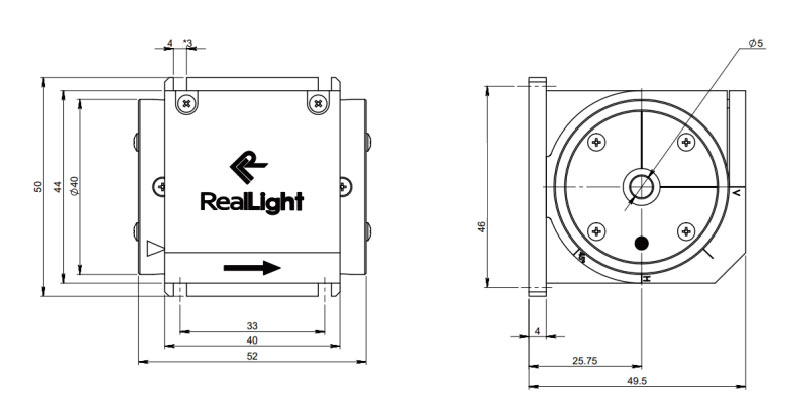
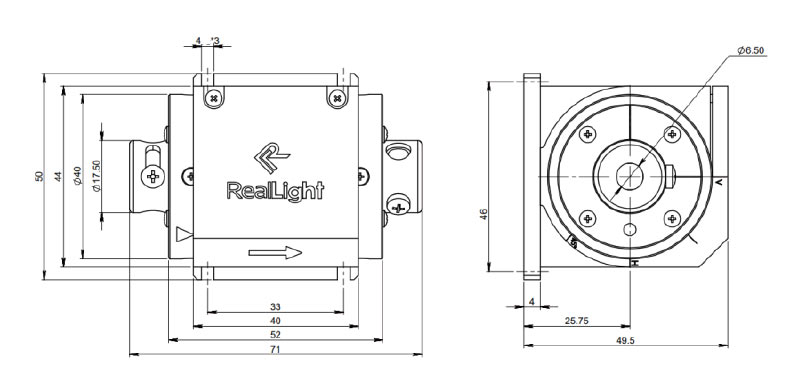
Mechanical Drawings (Unit: mm)
Faraday Rotator Size Diagram
Optical Isolator Size Diagram

 MCD Series 350ps Low Repetition Rate OEM Microchip Laser 1064nm1064nm
 Articulated Arm and Handpieces for Picosecond Laser1064nm, 650nm, 532nm





 777
777