
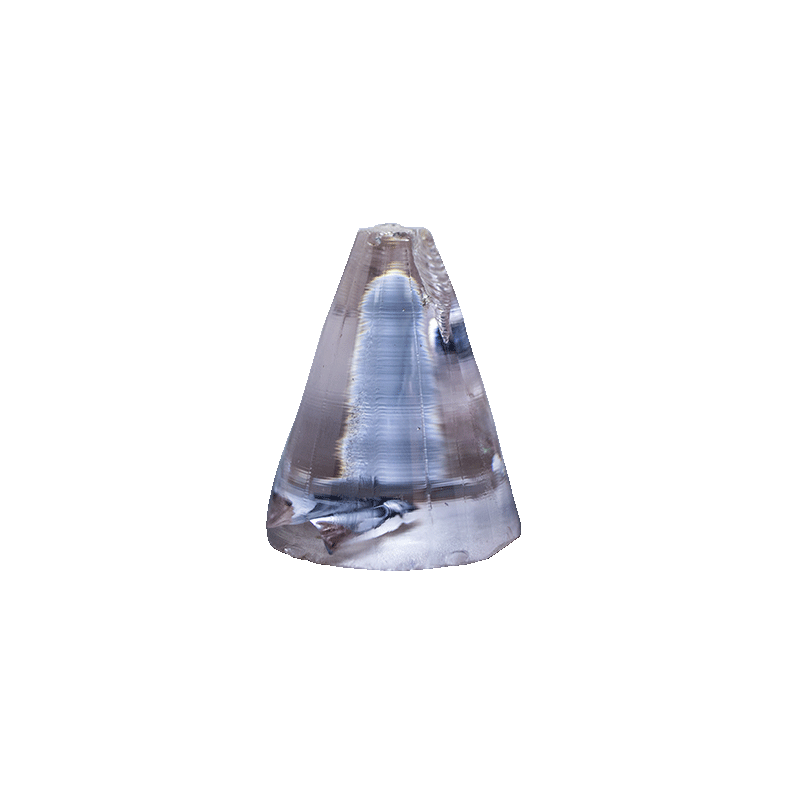
Nd: YAG crystal, also known as a neodymium-doped yttrium aluminum garnet crystal, is a laser medium crystal with good comprehensive properties used for solid-state lasers.
The atoms in the Nd:YAG crystal are excited by the flashlamp, and the crystal produces amplified light that propagates at a specific wavelength (1064 nm). Nd:YAG is one of the well-established laser crystals obtained by doping Nd ions into YAG crystals.
Nd:YAG laser crystals have absorption bandwidths of 730-760 nm and 790-820 nm and are usually pumped by flash tubes or laser diodes. Typical laser emission peaks at 1064 nm. Wavelengths at 946 nm, 1120 nm, 1320 nm, and 1440 nm lasers can also be emitted by different measurements. Q-switched and locked modes are suitable for obtaining lasers of different wavelengths (532 nm, 266 nm, 213 nm, etc.) and pulse widths (10-25ns).
Nd:YAG crystals are widely used in various solid-state laser systems – frequency-doubling continuous-wave switching, high-energy Q-switching, etc. Usually, high-concentration doped crystals are used in pulsed lasers, and low-concentration doped crystals are typically used for continuous-wave output.
Nd:YAG crystals have a wide range of applications in biophysics, medicine, machinery, scientific research, and architecture.
Laser Crystal Nd:YAG
APPLICATION
-
Holographic
-
Laser medicine
-
The laser marker
-
Radar and ranging
-
Medical applications
- Laser range finder
KEY FEATURES
-
High gain coefficient
/ -
High slope efficiency/
-
Laser threshold is low/
-
Wide absorption bandwidth/
-
Excellent optical, mechanical and physical properties/
PRODUCT PARAMETERS
| Material Specifications | |
| Neodymium Concentration Tolerance(atm%) | 0.1- 2.5(+/-0.1)atm% |
| Orientation | [001] or [110] or [111] <±0.5° |
| Parallelism | 10〞 |
| Vertical | 5ˊ |
| Surface Quality | 10-5 |
| Wavefront Distortion | λ/4@632 nm |
| Surface Flatness | λ/8@632 nm |
| Clear Aperture | >95 % |
| Chamfering | <0.2×45° |
| Length of Tolerance | +0.5/-0mm |
| Thickness/Diameter Tolerance | ±0.05 mm |
| The Largest Size | dia (3~12.7)×(3~150) mm |
| Damage Threshold | >750 MW/cm2@1064 nm 10 ns 10 Hz |
| Extinction Ratio | >30 dB(depends on the actual size) |
| Precision Grinding | 400 grit |
| Physical and Chemical Properties | |
| Crystal Structure | Cubic – la3d |
| Lattice Constant | 12.01 Å |
| Density | 4.56 g/cm3 |
| Melting Point | 1950 °C |
| Thermal Conductivity/(W·m-1·K-1 @ 25°C) | 14 |
| Specific Heat/(J·g-1·K-1) | 0.59 |
| Fracture Stress | 1.3-2.6*103 kg/cm2 |
| Thermal Expansion Rate/(10-6·K-1 @ 25°C) | [100] Orientation–8.2 [110] Orientation–7.7 [111] Orientation–7.8 |
| Mohs Hardness | 8.5 |
| Young’s Modulus/ Gpa | 317 |
| Shear Modulus/ Gpa | 54.66 |
| Extinction Ratio | 25 dB |
| Poisson Ratio | 0.25 |
| Optical and Spectral Properties | |
| Laser Transition | 4F3/2 →4I11/2 |
| Photon Energy | 1.86×10⁻¹⁹ J |
| Laser Transition Wavelength,λl(nm) | 1064 |
| Pump Transition Wavelength,λp(nm) | 808 |
| Pump Transition Bandwidth,Δλp(nm) | <4 |
| Laser Transition Bandwidth,Δλl(nm) | ~0.6 |
| Pump Transition Peak Section,σp(E-20 cm2) | 6.7 |
| Cross Section of Laser Transition Peak,σl(E-20 cm2) | 28 |
| Pump Transition Saturation Strengthφp(kW / cm2) | 12 |
| Laser Transition Saturation Intensityφl(kW / cm2) | 2.6 |
| Laser Transition Saturation Flux Γl,sat(J / cm2) | 0.6 |
| Minimum Pump Strength Lmin(kW / cm2) | ~0 |
| Upper Laser Tube Life,τ(ms) | 0.26 |
| Quantum Defect Fraction | 0.24 |
| Fractional Heat Generation | 0.37 |
| Refractive Index | 1.8197 @1.064 µm |
| Fluorescence Lifetime | 230 µs |
RECOMMENDED PRODUCTS





 777
777